The Day Care Fix Kit
Built for day care owners, home child care providers and preschool operators.
Honest answer — this is a trade where almost everybody prices off what the place down the road charges instead of what a child actually costs to care for. This kit finds where the money leaks in your own work and gives you the steps and the words to close each one.
Opens secure checkout. Instant download after payment. 30 days to ask for a refund — refund policy · terms
The 13 leaks it covers
8 you can close it · 4 the other side owes it · 1 a pro decides
- Tuition set by the neighborhood, not by what a child costsWhere to look first: Add up one month of costs: staff pay and payroll costs, rent and utilities, food, supplies, insurance, licensing, and your own pay.Keep it from coming back: Re-run cost per child per day every quarter and before any enrollment season.You can close it
- Home day care: share of the house not claimed, only suppliesWhere to look first: If you run day care in your home, check that your state license, registration or exemption is current. The home deduction depends on it.Keep it from coming back: Log hours and meals daily. File home bills monthly. Keep your license current.You can close it
- Staff hours scheduled flat all day instead of matched to attendanceWhere to look first: For two weeks, write down how many children are in each room every half hour, from open to close.Keep it from coming back: Re-check the attendance-by-half-hour picture every quarter and every time enrollment changes.You can close it
- Rent and building costs per child never recalculated as enrollment changesWhere to look first: Add up everything the building costs you each month: rent, utilities, water, laundry, cleaning, repairs.Keep it from coming back: Building cost per child worked out every month. Lease dates on the calendar.You can close it
- Supplies bought out of pocket and never put through the booksWhere to look first: For one month, keep every receipt for anything bought for the center, including the quick store runs paid with your own card.Keep it from coming back: One business card for center purchases. Receipts captured the same day. Subscriptions reviewed every quarter.You can close it
- Staff turnover cost felt but never countedWhere to look first: Nothing recovers this cost once someone leaves. What you can do is count it and slow it down.Keep it from coming back: Count the cost of every departure. Stay conversations every quarter.You can close it
- Price set without checking the state's published market rate surveyWhere to look first: Find your state's child care market rate survey. Federal rules require every state to survey what providers charge, broken out by area, type of provider and age of child, and to post the report online.Keep it from coming back: Check the market rate survey each time your state posts a new one, about every three years, and when you update tuition.You can close it
- Licensed seats sitting empty while rent and staff are paid in fullWhere to look first: Write down, for each age room: how many children you are licensed and staffed for, and how many are enrolled today.Keep it from coming back: Count empty seats by room every Monday. Every inquiry gets an answer the same day.You can close it
- Late and unpaid tuition carried for monthsWhere to look first: Make one list of every family that owes money: name, amount, how long it has been owed.Keep it from coming back: Signed payment policy at enrollment. Weekly balance check. Autopay offered to every family.The other side owes it
- Card and bank fees taken off tuition before it landsWhere to look first: Pull one month of tuition payments. For each, write what the parent paid and what landed in your account.Keep it from coming back: Check the fees on one month's statement every quarter against the rate you were given in writing.The other side owes it
- Subsidy payments late, short, or never claimedWhere to look first: Get the current provider handbook from your state's child care subsidy agency. Highlight how to bill, absence and closure days, payment dates, and the deadline for corrections.Keep it from coming back: Match subsidy payments to attendance every pay period. Correction deadlines on the calendar.The other side owes it
- Food program reimbursement never joined, or claimed shortWhere to look first: If you're not on the Child and Adult Care Food Program (CACFP), contact your state's CACFP agency. Centers can apply through the state agency or a sponsor. Family day care homes take part through a sponsoring organization.Keep it from coming back: Meal counts recorded at the time of service, every day. Claim checked against them before it goes in.The other side owes it
- Child care insurance renewed untouched for years; compliance costs never pricedWhere to look first: Pull your current liability policy. Write down the premium, the coverage limits, the deductible and the renewal date.Keep it from coming back: Shop the policy 60–90 days before every renewal. Keep one list of every compliance cost and its date.A pro decides
Free: one full leak from this kit
No sign-up, no email. Here is leak 1 of 13 exactly as it appears in the kit, so you can see what you get before you buy.
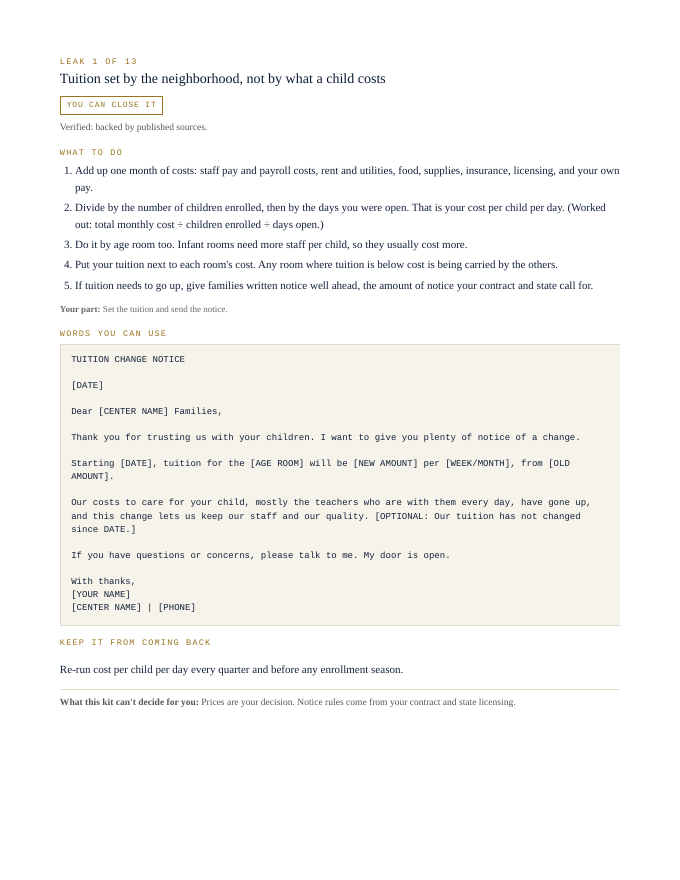
Tuition set by the neighborhood, not by what a child costs
You can close it- Add up one month of costs: staff pay and payroll costs, rent and utilities, food, supplies, insurance, licensing, and your own pay.
- Divide by the number of children enrolled, then by the days you were open. That is your cost per child per day. (Worked out: total monthly cost ÷ children enrolled ÷ days open.)
- Do it by age room too. Infant rooms need more staff per child, so they usually cost more.
- Put your tuition next to each room's cost. Any room where tuition is below cost is being carried by the others.
- If tuition needs to go up, give families written notice well ahead, the amount of notice your contract and state call for.
Your part: Set the tuition and send the notice.
TUITION CHANGE NOTICE

[DATE]

Dear [CENTER NAME] Families,

Thank you for trusting us with your children. I want to give you plenty of notice of a change.

Starting [DATE], tuition for the [AGE ROOM] will be [NEW AMOUNT] per [WEEK/MONTH], from [OLD AMOUNT].

Our costs to care for your child, mostly the teachers who are with them every day, have gone up, and this change lets us keep our staff and our quality. [OPTIONAL: Our tuition has not changed since DATE.]

If you have questions or concerns, please talk to me. My door is open.

With thanks,
[YOUR NAME]
[CENTER NAME] | [PHONE]
Re-run cost per child per day every quarter and before any enrollment season.
What this kit can't decide for you: Prices are your decision. Notice rules come from your contract and state licensing.
That's 1 of 13. The other 12 come the same way in the kit: steps, words to send, a habit to keep each one closed.
Opens secure checkout. Instant download after payment. 30 days to ask for a refund — refund policy · terms
What people in this work look up
When day care owners and home child care providers go looking for answers, they search things like “daycare business plan”, “daycare rates”, “daycare business”, “daycare tuition” and “how much to charge for daycare”. Those searches turn up forms, averages and other people's numbers. This kit starts from your own records instead: the 13 places money leaks in this work, where to look first and the words to send to close each one.
What you get for each leak
- Numbered steps to close each leak
- Your part, spelled out
- Words you can use: letters and scripts, ready to send (fill in the brackets)
- A habit that keeps each leak from coming back
- An honest line on what the kit can't decide for you
A page from the kit
Questions people ask
How much should I charge for daycare?
Set tuition by what a child costs you to care for, not by the neighborhood, and check your state's market rate survey. The kit walks you through both.
What can a home daycare deduct?
The share of your house you use for care, not only supplies. The kit shows how to figure it.
Am I claiming child care subsidy and food program money correctly?
Subsidy payments run late, short or unclaimed, and the food program is often never joined. The kit covers both.
What it can't decide for you
This kit works from your own records. It doesn't give legal, tax, licensing or financial advice, and it never tells you what to charge. Where a CPA, attorney, insurer or state board makes the call, the kit says so and gets your records ready for them.
17-page PDF · instant download after payment · Code VYR-KIT-POPPY-01
Opens secure checkout. Instant download after payment. 30 days to ask for a refund — refund policy · terms
Use Jobber or Housecall Pro? Run the free leak check — it reads your job export in your browser and shows the money leaks the software doesn't flag. Nothing is uploaded.