The EMTs & Paramedics Fix Kit
Built for EMTs and paramedics.
EMTs and paramedics search the salary number, but most of the money that gets away is hours: sleep time deducted on a 24 that never let you sleep, a shift differential left out of your overtime rate, a work-period rule that may not even apply to you, truck checks and run reports done off the clock, and a new overtime deduction most crews have never heard of. I wrote this kit so you can check each one against your own schedule and stubs, and ask in writing.
Opens secure checkout. Instant download after payment. 30 days to ask for a refund — refund policy · terms
The 6 leaks it covers
5 the other side owes it · 1 a pro decides
- Sleep time deducted on 24-hour shifts when the night was not really freeWhere to look first: Check your pay stubs for 24-hour shifts. Look for a sleep-time or unpaid-hours deduction.Keep it from coming back: Write down call times during sleep hours before you go off shift, every 24.The other side owes it
- Shift differential and bonuses left out of the overtime rateWhere to look first: Pull two stubs with overtime on them.Keep it from coming back: Check one stub a month: base plus differentials, divided by hours, then compare to the overtime rate paid.The other side owes it
- Fire-service work period applied to a medic who may not meet the testWhere to look first: Ask payroll in writing whether you are paid on a standard 40-hour week or a section 7(k) fire protection work period.Keep it from coming back: Ask the work-period question again whenever your role, station or employer changes.The other side owes it
- Truck checks, restocking and run reports done off the clockWhere to look first: For two weeks, write down your clock-in time, when you actually started the rig check, when your last report was finished, and your clock-out time.Keep it from coming back: Report every interrupted break the same shift, in writing, the way policy says.The other side owes it
- The new overtime deduction left off the returnWhere to look first: For tax years 2025 through 2028 there is a federal deduction for qualified overtime pay (VERIFIED: Iowa State CALT summary of IRS guidance).Keep it from coming back: Keep a running overtime list by pay period all year.A pro decides
- Pay never checked against your certification level and the published medianWhere to look first: Find your employer's pay scale and your certification level: EMT, AEMT or paramedic, plus any FTO, critical care or community paramedic pay.Keep it from coming back: Send your new card to payroll the day you upgrade, and check the next stub.The other side owes it
Free: one full leak from this kit
No sign-up, no email. Here is leak 1 of 6 exactly as it appears in the kit, so you can see what you get before you buy.
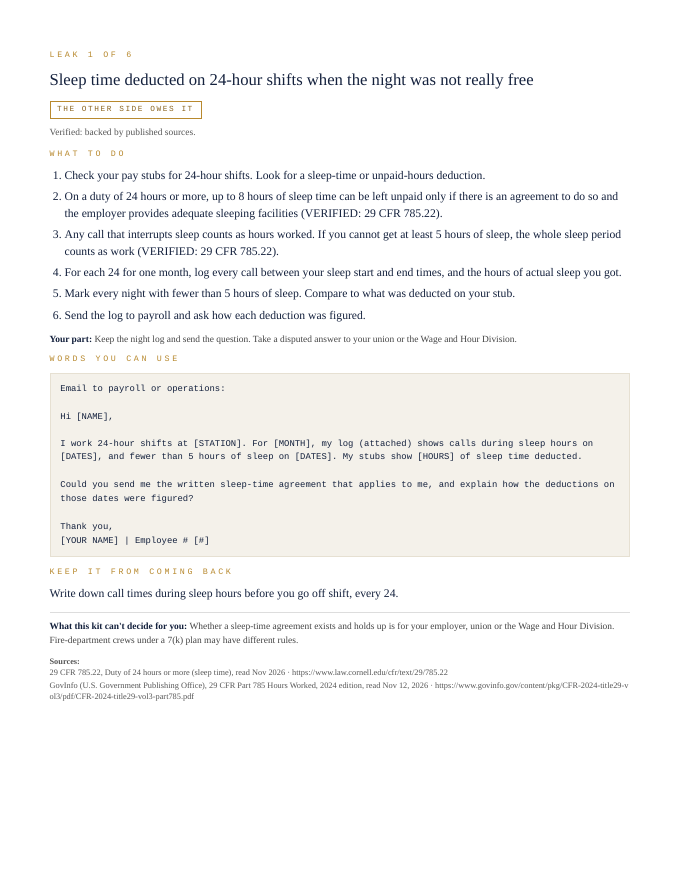
Sleep time deducted on 24-hour shifts when the night was not really free
The other side owes it- Check your pay stubs for 24-hour shifts. Look for a sleep-time or unpaid-hours deduction.
- On a duty of 24 hours or more, up to 8 hours of sleep time can be left unpaid only if there is an agreement to do so and the employer provides adequate sleeping facilities (VERIFIED: 29 CFR 785.22).
- Any call that interrupts sleep counts as hours worked. If you cannot get at least 5 hours of sleep, the whole sleep period counts as work (VERIFIED: 29 CFR 785.22).
- For each 24 for one month, log every call between your sleep start and end times, and the hours of actual sleep you got.
- Mark every night with fewer than 5 hours of sleep. Compare to what was deducted on your stub.
- Send the log to payroll and ask how each deduction was figured.
Your part: Keep the night log and send the question. Take a disputed answer to your union or the Wage and Hour Division.
Email to payroll or operations:


Hi [NAME],

I work 24-hour shifts at [STATION]. For [MONTH], my log (attached) shows calls during sleep hours on [DATES], and fewer than 5 hours of sleep on [DATES]. My stubs show [HOURS] of sleep time deducted.

Could you send me the written sleep-time agreement that applies to me, and explain how the deductions on those dates were figured?

Thank you,
[YOUR NAME] | Employee # [#]
Write down call times during sleep hours before you go off shift, every 24.
What this kit can't decide for you: Whether a sleep-time agreement exists and holds up is for your employer, union or the Wage and Hour Division. Fire-department crews under a 7(k) plan may have different rules.
That's 1 of 6. The other 5 come the same way in the kit: steps, words to send, a habit to keep each one closed.
Opens secure checkout. Instant download after payment. 30 days to ask for a refund — refund policy · terms
What people in this work look up
When EMTs and paramedics go looking for answers, they search things like “emt salary”, “paramedic salary”, “emt overtime” and “paramedic pay”. Those searches turn up forms, averages and other people's numbers. This kit starts from your own records instead: the 6 places money leaks in this work, where to look first and the words to send to close each one.
What you get for each leak
- Numbered steps to close each leak
- Your part, spelled out
- Words you can use: letters and scripts, ready to send (fill in the brackets)
- A habit that keeps each leak from coming back
- An honest line on what the kit can't decide for you
A page from the kit
Questions people ask
Sleep time deducted on 24-hour shifts when the night was not really free: where do I start?
Start here: Check your pay stubs for 24-hour shifts. Look for a sleep-time or unpaid-hours deduction. To keep it from coming back: Write down call times during sleep hours before you go off shift, every 24.
Shift differential and bonuses left out of the overtime rate: where do I start?
Start here: Pull two stubs with overtime on them. To keep it from coming back: Check one stub a month: base plus differentials, divided by hours, then compare to the overtime rate paid.
Fire-service work period applied to a medic who may not meet the test: where do I start?
Start here: Ask payroll in writing whether you are paid on a standard 40-hour week or a section 7(k) fire protection work period. To keep it from coming back: Ask the work-period question again whenever your role, station or employer changes.
What it can't decide for you
This kit works from your own records. It doesn't give legal, tax, licensing or financial advice, and it never tells you what to charge. Where a CPA, attorney, insurer or state board makes the call, the kit says so and gets your records ready for them.
12-page PDF · instant download after payment · Code VYR-KIT-EMTS-01
Opens secure checkout. Instant download after payment. 30 days to ask for a refund — refund policy · terms
Next step
- Run your free LeakReceipts check — it reads your own receipts and records and shows where money is leaking out, line by line.
- TrueNET — the whole-picture money truth: what you actually keep after every cost, across everything you earn and spend.
Use Jobber or Housecall Pro? Run the free leak check — it reads your job export in your browser and shows the money leaks the software doesn't flag. Nothing is uploaded.