The Musicians Fix Kit
Built for musicians, singers, rappers, producers and songwriters.
The winners in this trade aren't necessarily the biggest streamers — they're the ones who registered everything. This kit finds where the money leaks in your own work and gives you the steps and the words to close each one.
Opens secure checkout. Instant download after payment. 30 days to ask for a refund — refund policy · terms
The 11 leaks it covers
7 you can close it · 2 the other side owes it · 2 a pro decides
- Door deal with no guaranteed minimum — attendance risk carried by the musicianWhere to look first: Take your last door deal and run it twice: what you'd have been paid if 20 people came, and if 100 came. That's the risk you're carrying.Keep it from coming back: Know your own cost to play before you answer any offer. Judge each door deal at low turnout, not best case.You can close it
- Co-written songs with no signed split sheet — default co-ownershipWhere to look first: List every song where someone else had a hand in it: producer, feature, co-writer, bandmate.Keep it from coming back: No session ends without a signed split sheet. Register a song only after the sheet is signed.You can close it
- 35-year termination right — notice window closes before the recapture window opensWhere to look first: Find every agreement where you signed over masters or publishing, and the date you signed it.Keep it from coming back: Keep every signed agreement with its signing date. Calendar the notice-window opening date the day you sign.You can close it
- Gear and studio time never counted as business cost (pride economy)Where to look first: Buying gear and studio time is your choice, not a leak. The only fix is counting it. Gather this year's receipts for instruments, recording gear, software, and studio time.Keep it from coming back: Snap every gear or studio receipt on the day you pay.You can close it
- Missing one of the four royalty registrations (distributor, PRO, MLC, SoundExchange)Where to look first: Write down the four places one song gets paid from, and check each one off: a) A distributor or label (pays for the recording on streams and downloads). B) A PRO — ASCAP, BMI, SESAC or GMR (pays the songwriter for performances).Keep it from coming back: Register every new release on all four the week it comes out. Re-check the list once a quarter.You can close it
- Songs and recordings not registered within three months of releaseWhere to look first: List every song you've released, with the release date.Keep it from coming back: Put the three-month registration date on the calendar the day a release date is set. File in release week.You can close it
- No SoundExchange account of your own — the artist's 45% sits unclaimedWhere to look first: Check whether you have a SoundExchange account in your own name. Your distributor's or your PRO's account does not count — they collect different money.Keep it from coming back: Claim every new recording at SoundExchange the week it is released.You can close it
- Tracks under 1,000 streams a year earn no Spotify recording royaltiesWhere to look first: Pull your Spotify for Artists or distributor report for the last 12 months, per track.Keep it from coming back: Check the per-track 12-month stream count every quarter.The other side owes it
- Door split agreed verbally — no written number to check the payout againstWhere to look first: For your last few shows, write down what you were told the split was and what you were actually paid.Keep it from coming back: No show is played without a written confirmation of the split and the costs taken out first.The other side owes it
- Catalog never offered for sync licensingWhere to look first: Nothing is owed here — this is a door you haven't opened yet. Pick the songs you own outright (both the composition and the master) or can clear with your co-owners in writing. Those are the ones a music supervisor can license fast.Keep it from coming back: Keep an instrumental and a clean version of every new song, and a signed split sheet, so each release is ready for sync the day it comes out.A pro decides
- Show, royalty and platform money spent with nothing set aside for self-employment taxWhere to look first: Open a separate savings account just for taxes.Keep it from coming back: Make the tax-account transfer the first thing you do when any payment lands.A pro decides
Free: one full leak from this kit
No sign-up, no email. Here is leak 1 of 11 exactly as it appears in the kit, so you can see what you get before you buy.
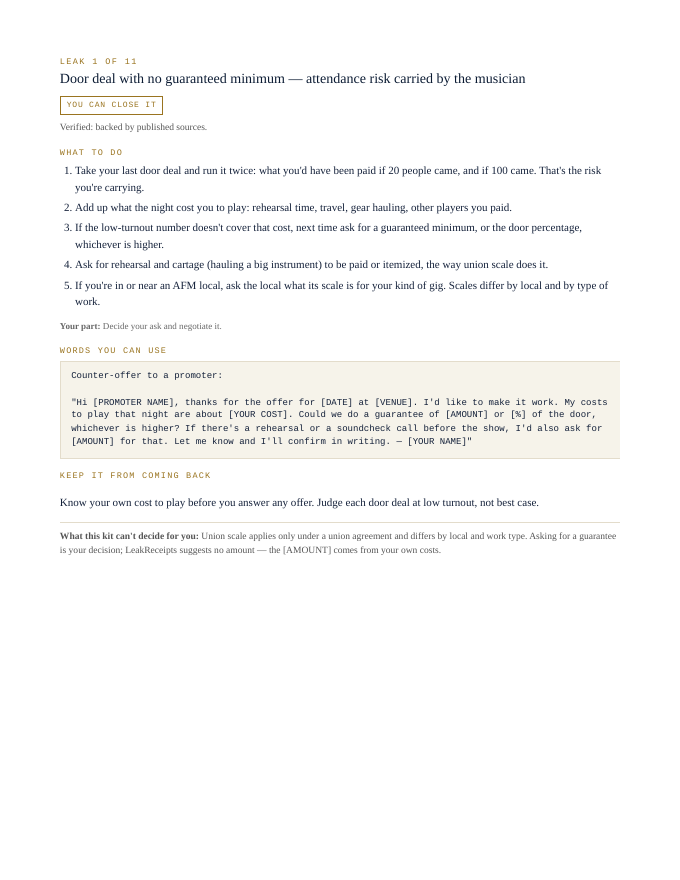
Door deal with no guaranteed minimum — attendance risk carried by the musician
You can close it- Take your last door deal and run it twice: what you'd have been paid if 20 people came, and if 100 came. That's the risk you're carrying.
- Add up what the night cost you to play: rehearsal time, travel, gear hauling, other players you paid.
- If the low-turnout number doesn't cover that cost, next time ask for a guaranteed minimum, or the door percentage, whichever is higher.
- Ask for rehearsal and cartage (hauling a big instrument) to be paid or itemized, the way union scale does it.
- If you're in or near an AFM local, ask the local what its scale is for your kind of gig. Scales differ by local and by type of work.
Your part: Decide your ask and negotiate it.
Counter-offer to a promoter:

"Hi [PROMOTER NAME], thanks for the offer for [DATE] at [VENUE]. I'd like to make it work. My costs to play that night are about [YOUR COST]. Could we do a guarantee of [AMOUNT] or [%] of the door, whichever is higher? If there's a rehearsal or a soundcheck call before the show, I'd also ask for [AMOUNT] for that. Let me know and I'll confirm in writing. — [YOUR NAME]"
Know your own cost to play before you answer any offer. Judge each door deal at low turnout, not best case.
What this kit can't decide for you: Union scale applies only under a union agreement and differs by local and work type. Asking for a guarantee is your decision; LeakReceipts suggests no amount — the [AMOUNT] comes from your own costs.
That's 1 of 11. The other 10 come the same way in the kit: steps, words to send, a habit to keep each one closed.
Opens secure checkout. Instant download after payment. 30 days to ask for a refund — refund policy · terms
What people in this work look up
When musicians and music creators go looking for answers, they search things like “music royalties”, “soundexchange”, “mechanical royalties” and “bmi vs ascap”. Those searches turn up forms, averages and other people's numbers. This kit starts from your own records instead: the 11 places money leaks in this work, where to look first and the words to send to close each one.
What you get for each leak
- Numbered steps to close each leak
- Your part, spelled out
- Words you can use: letters and scripts, ready to send (fill in the brackets)
- A habit that keeps each leak from coming back
- An honest line on what the kit can't decide for you
A page from the kit
Questions people ask
Which royalty registrations do I need?
Distributor, PRO, MLC and SoundExchange: missing any one leaves money unclaimed. The kit walks you through all four.
Why should I sign up with SoundExchange?
Without your own account, the artist's share sits unclaimed. The kit shows how.
Do I need a split sheet?
Yes. Co-written songs with no signed split sheet default to co-ownership. The kit has the words to use.
What it can't decide for you
This kit works from your own records. It doesn't give legal, tax, licensing or financial advice, and it never tells you what to charge. Where a CPA, attorney, insurer or state board makes the call, the kit says so and gets your records ready for them.
15-page PDF · instant download after payment · Code VYR-KIT-MELODY-01
Opens secure checkout. Instant download after payment. 30 days to ask for a refund — refund policy · terms
Use Jobber or Housecall Pro? Run the free leak check — it reads your job export in your browser and shows the money leaks the software doesn't flag. Nothing is uploaded.