The Oil Rig & Offshore Workers Fix Kit
Built for oil rig and offshore workers.
On a rig, the check is built from a hitch schedule, a day rate or an hourly rate, travel days and standby time, and each piece has its own rule. The leaks I see most aren't in the rate you were quoted. They're in the hours nobody counted: crew-change travel, weather holds at the heliport, a hitch that splits across two workweeks, and certificates and gear you paid for yourself. Work from your own stubs and your own hitch log; that paper is the proof. This kit finds where the money leaks in your own work and gives you the steps and the words to close each one.
Opens secure checkout. Instant download after payment. 30 days to ask for a refund — refund policy · terms
The 6 leaks it covers
5 the other side owes it · 1 a pro decides
- Day rate paid with no overtime line on the stubWhere to look first: Pull the stubs for your last two hitches and write down how you were paid: day rate, hourly, or salary.Keep it from coming back: Log your hours per 7-day workweek every hitch, and check the stub against the log the day it posts.The other side owes it
- Crew-change travel days never counted as hours workedWhere to look first: For each crew change, write down when you left home, when you reached the report point, the heliport or dock, and when you got to the rig.Keep it from coming back: Write the travel times in your hitch log every crew change, the same day.The other side owes it
- Weather holds and waiting at the heliport or dock unpaidWhere to look first: Every time a flight or boat is delayed, write down where you were told to wait, for how long, and whether you were free to leave.Keep it from coming back: Write down every hold the day it happens: place, start, end, and whether you could leave.The other side owes it
- A hitch split across two workweeks hides overtimeWhere to look first: Find your employer's fixed workweek: the day and time it starts. Ask payroll if you don't know it.Keep it from coming back: Count overtime per workweek every hitch, not per hitch.The other side owes it
- Certificates, medicals and gear paid out of your own pocketWhere to look first: List what you paid for yourself this year: offshore survival and escape training, safety certificates, medical exams, credential fees, required boots and PPE.Keep it from coming back: Ask who pays before you book any renewal, and keep every receipt in one folder.The other side owes it
- Hurt offshore without knowing which system paysWhere to look first: Report the injury in writing the same day and ask for a copy of the incident report.Keep it from coming back: Report every injury in writing the day it happens, however small.A pro decides
Free: one full leak from this kit
No sign-up, no email. Here is leak 1 of 6 exactly as it appears in the kit, so you can see what you get before you buy.
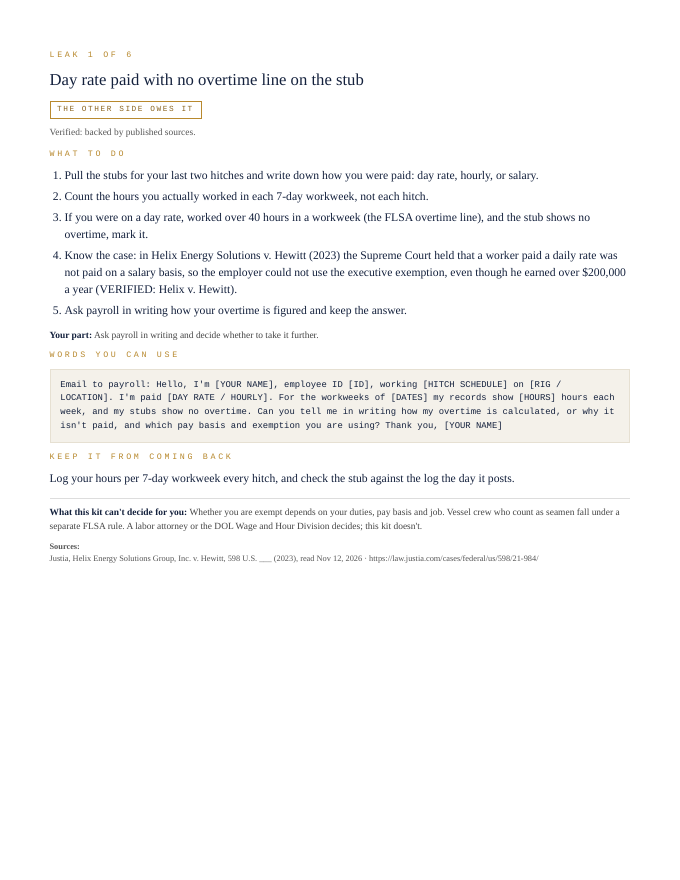
Day rate paid with no overtime line on the stub
The other side owes it- Pull the stubs for your last two hitches and write down how you were paid: day rate, hourly, or salary.
- Count the hours you actually worked in each 7-day workweek, not each hitch.
- If you were on a day rate, worked over 40 hours in a workweek (the FLSA overtime line), and the stub shows no overtime, mark it.
- Know the case: in Helix Energy Solutions v. Hewitt (2023) the Supreme Court held that a worker paid a daily rate was not paid on a salary basis, so the employer could not use the executive exemption, even though he earned over $200,000 a year (VERIFIED: Helix v. Hewitt).
- Ask payroll in writing how your overtime is figured and keep the answer.
Your part: Ask payroll in writing and decide whether to take it further.
Email to payroll:

Hello, I'm [YOUR NAME], employee ID [ID], working [HITCH SCHEDULE] on [RIG / LOCATION]. I'm paid [DAY RATE / HOURLY]. For the workweeks of [DATES] my records show [HOURS] hours each week, and my stubs show no overtime. Can you tell me in writing how my overtime is calculated, or why it isn't paid, and which pay basis and exemption you are using? Thank you, [YOUR NAME]
Log your hours per 7-day workweek every hitch, and check the stub against the log the day it posts.
What this kit can't decide for you: Whether you are exempt depends on your duties, pay basis and job. Vessel crew who count as seamen fall under a separate FLSA rule. A labor attorney or the DOL Wage and Hour Division decides; this kit doesn't.
That's 1 of 6. The other 5 come the same way in the kit: steps, words to send, a habit to keep each one closed.
Opens secure checkout. Instant download after payment. 30 days to ask for a refund — refund policy · terms
What people in this work look up
When oil rig and offshore workers go looking for answers, they search things like “offshore oil rig salary”, “oil rig worker pay”, “offshore jobs pay” and “oil rig salary”. Those searches turn up forms, averages and other people's numbers. This kit starts from your own records instead: the 6 places money leaks in this work, where to look first and the words to send to close each one.
What you get for each leak
- Numbered steps to close each leak
- Your part, spelled out
- Words you can use: letters and scripts, ready to send (fill in the brackets)
- A habit that keeps each leak from coming back
- An honest line on what the kit can't decide for you
A page from the kit
Questions people ask
Day rate paid with no overtime line on the stub: where do I start?
Start here: Pull the stubs for your last two hitches and write down how you were paid: day rate, hourly, or salary. To keep it from coming back: Log your hours per 7-day workweek every hitch, and check the stub against the log the day it posts.
Crew-change travel days never counted as hours worked: where do I start?
Start here: For each crew change, write down when you left home, when you reached the report point, the heliport or dock, and when you got to the rig. To keep it from coming back: Write the travel times in your hitch log every crew change, the same day.
Weather holds and waiting at the heliport or dock unpaid: where do I start?
Start here: Every time a flight or boat is delayed, write down where you were told to wait, for how long, and whether you were free to leave. To keep it from coming back: Write down every hold the day it happens: place, start, end, and whether you could leave.
What it can't decide for you
This kit works from your own records. It doesn't give legal, tax, licensing or financial advice, and it never tells you what to charge. Where a CPA, attorney, insurer or state board makes the call, the kit says so and gets your records ready for them.
12-page PDF · instant download after payment · Code VYR-KIT-OFFSHORE-01
Opens secure checkout. Instant download after payment. 30 days to ask for a refund — refund policy · terms
Next step
- Run your free LeakReceipts check — it reads your own receipts and records and shows where money is leaking out, line by line.
- TrueNET — the whole-picture money truth: what you actually keep after every cost, across everything you earn and spend.
Use Jobber or Housecall Pro? Run the free leak check — it reads your job export in your browser and shows the money leaks the software doesn't flag. Nothing is uploaded.