The Owner-Operator Trucking Fix Kit
Built for owner-operators: leased on or running their own authority.
The ones who did well in this business mostly won the same way — they knew a number nobody else bothered to know. This kit finds where the money leaks in your own work and gives you the steps and the words to close each one.
Opens secure checkout. Instant download after payment. 30 days to ask for a refund — refund policy · terms
The 17 leaks it covers
9 you can close it · 4 the other side owes it · 4 a pro decides
- Tires bought under pressure when one goes, and pressure left uncheckedWhere to look first: Check your tire pressures cold, with your own gauge, on a set day each week as part of your pre-trip.Keep it from coming back: Weekly cold pressure check, and replacement quotes in hand before the tread says you need them.You can close it
- Parking — paid spots and unpaid hunting time left out of the numbersWhere to look first: Add paid parking to your cost per mile as its own line, and keep every parking receipt.Keep it from coming back: Plan the night's stop before you roll, and log every parking cost and every hunt.You can close it
- No reference number to check a broker's rate againstWhere to look first: Know your own cost per mile first. That is the number every offer has to clear.Keep it from coming back: Log every offer and every rate you take, by lane. Know your floor before the phone rings.You can close it
- Maintenance — roadside breakdowns instead of planned shop workWhere to look first: Pull every repair invoice from the last year. Mark each one: planned (a shop you chose) or roadside (where it broke). Next to each roadside one, write down the days you were down, the tow, and the hotel.Keep it from coming back: Book preventive work by miles at a shop you chose, and put a set amount per mile into a repair reserve every settlement.You can close it
- No cost-per-mile floor — loads judged without the number they must clearWhere to look first: Pull your costs for the last three months (a full year is better): fuel, truck and trailer payment, insurance, repairs and tires, plates, permits and IFTA, tolls, parking, factoring fees, phone, ELD and load board, and what you pay yourself.Keep it from coming back: Recalculate your cost per mile every month on total miles, not loaded miles, and check every load against it before you say yes.You can close it
- Detention, TONU and accessorials earned but never billedWhere to look first: On flatbed, detention is rare and there are no lumper fees — lumpers are a dry van and reefer thing. Tarp pay is usually inside the all-in rate, not billed after. So the money here is mostly set up before you accept.Keep it from coming back: No terms on the rate con, no booking: get detention, TONU and tarp terms in writing before you accept, and bill accessorials on the same invoice as the load.You can close it
- Deadhead — rate per mile figured on loaded miles onlyWhere to look first: For last month, pull your TOTAL miles from your ELD or odometer, and your LOADED miles from your rate confirmations.Keep it from coming back: Never figure a rate on loaded miles alone. Count the empty miles to the pickup — and think about the reload out — before you say yes.You can close it
- Permits, plates, IFTA, tolls and scales — late penalties and charges nobody checksWhere to look first: Make one list of every compliance item and its due date: your IFTA fuel-tax returns, plates, any state permits, toll transponder accounts, and anything else you renew. Put each on a calendar 30 days early.Keep it from coming back: Every compliance date on a calendar 30 days early, fuel receipts matched to miles every month — not at the end of the quarter.You can close it
- Fuel bought where the tank runs low, not where the price is bestWhere to look first: Pull last month's fuel receipts. For each: gallons, total paid, and where. Total paid ÷ gallons = what you really paid per gallon (worked out).Keep it from coming back: Plan your fuel stops the night before by net price per gallon at stops in range.You can close it
- Factoring — the real cost per load after every fee, not the headline rateWhere to look first: Pull your factoring agreement and your last three months of factoring statements.Keep it from coming back: Before you sign any factoring agreement, get the full fee list, the term and the exit terms in writing. Grade every load on what lands after factoring.The other side owes it
- Lease-purchase settlement deductions nobody has added upWhere to look first: Before you sign any lease-purchase, read the deductions, escrow and payment sections first. If you are already in one, pull one settlement statement and your full lease, including every addendum.Keep it from coming back: Before you sign, read the deductions, escrow and payment sections of the lease. After you sign, add up the deductions column on every settlement.The other side owes it
- Fuel card fees that eat the discountWhere to look first: Pull your last two or three fuel card statements.Keep it from coming back: Before you sign up for any fuel card, get the full fee list in writing and check the network against the stops on your real lanes.The other side owes it
- Rated freight bill and broker records — what you can actually see, by how you are paidWhere to look first: The move that actually protects you come before you accept: know your own cost per mile and judge the load against it. What the broker kept does not change whether the load works for you.Keep it from coming back: Before you sign a lease or a broker-carrier agreement, find the clauses on how you are paid and on reviewing records. If you are paid a percentage, check the rated freight bill against every settlement as it arrives.The other side owes it
- Insurance renewed every year without being re-shoppedWhere to look first: Pull the declarations page for every policy you carry — liability, physical damage, cargo, and any others (non-trucking or bobtail, occupational accident, trailer interchange).Keep it from coming back: Put every renewal date on a calendar with a reminder well ahead of it, and ask for written re-quotes every year — not just when the price jumps.A pro decides
- Subscriptions and small recurring charges that renew past their useWhere to look first: Pull three months of bank and card statements.Keep it from coming back: Every new subscription goes on the renewal calendar the day you sign up.A pro decides
- Truck note terms — rate, balloon and total cost hidden under the monthly paymentWhere to look first: Pull your signed note or lease-purchase contract — the signed copy, not the sales sheet.Keep it from coming back: Before you sign the next truck note, get the APR, the total of all payments, the balloon and the prepayment penalty in writing, and run the total against the truck's value first.A pro decides
- Self-employment tax not set aside separately from income taxWhere to look first: This is not a mistake to fix — it is how being your own boss works. You pay both halves of Social Security and Medicare that an employer would split with a company driver. The leak is only a surprise at filing time.Keep it from coming back: Move your CPA's set share into the tax account the day each settlement lands — before anything else gets paid.A pro decides
Free: one full leak from this kit
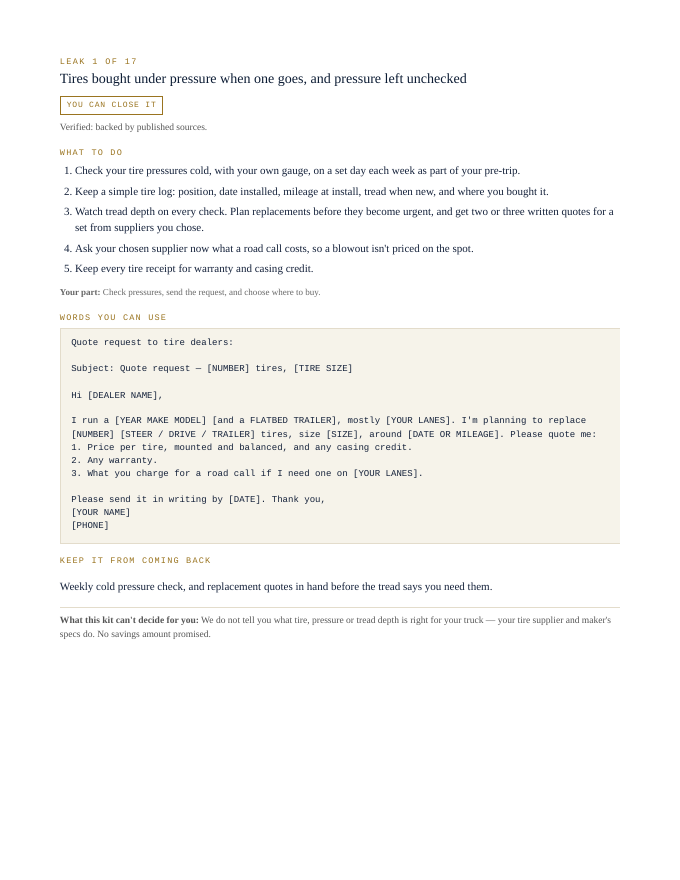
No sign-up, no email. Here is leak 1 of 17 exactly as it appears in the kit, so you can see what you get before you buy.
Tires bought under pressure when one goes, and pressure left unchecked
You can close it- Check your tire pressures cold, with your own gauge, on a set day each week as part of your pre-trip.
- Keep a simple tire log: position, date installed, mileage at install, tread when new, and where you bought it.
- Watch tread depth on every check. Plan replacements before they become urgent, and get two or three written quotes for a set from suppliers you chose.
- Ask your chosen supplier now what a road call costs, so a blowout isn't priced on the spot.
- Keep every tire receipt for warranty and casing credit.
Your part: Check pressures, send the request, and choose where to buy.
Quote request to tire dealers:

Subject: Quote request — [NUMBER] tires, [TIRE SIZE]

Hi [DEALER NAME],

I run a [YEAR MAKE MODEL] [and a FLATBED TRAILER], mostly [YOUR LANES]. I'm planning to replace [NUMBER] [STEER / DRIVE / TRAILER] tires, size [SIZE], around [DATE OR MILEAGE]. Please quote me:
1. Price per tire, mounted and balanced, and any casing credit.
2. Any warranty.
3. What you charge for a road call if I need one on [YOUR LANES].

Please send it in writing by [DATE]. Thank you,
[YOUR NAME]
[PHONE]
Weekly cold pressure check, and replacement quotes in hand before the tread says you need them.
What this kit can't decide for you: We do not tell you what tire, pressure or tread depth is right for your truck — your tire supplier and maker's specs do. No savings amount promised.
That's 1 of 17. The other 16 come the same way in the kit: steps, words to send, a habit to keep each one closed.
Opens secure checkout. Instant download after payment. 30 days to ask for a refund — refund policy · terms
What people in this work look up
When owner-operator truckers go looking for answers, they search things like “owner operator cost per mile”, “truck parking”, “factoring company”, “owner operator trucking” and “truck driver tax deductions”. Those searches turn up forms, averages and other people's numbers. This kit starts from your own records instead: the 17 places money leaks in this work, where to look first and the words to send to close each one.
What you get for each leak
- Numbered steps to close each leak
- Your part, spelled out
- Words you can use: letters and scripts, ready to send (fill in the brackets)
- A habit that keeps each leak from coming back
- An honest line on what the kit can't decide for you
A page from the kit
Questions people ask
What's my cost-per-mile floor?
The number every load must clear before you accept it. The kit walks you through building it.
What does factoring really cost per load?
Add every fee, not the headline rate. The kit shows how.
Am I billing detention, TONU and accessorials?
Earned but never billed is one of the biggest leaks. The kit gives you the words.
What it can't decide for you
This kit works from your own records. It doesn't give legal, tax, licensing or financial advice, and it never tells you what to charge. Where a CPA, attorney, insurer or state board makes the call, the kit says so and gets your records ready for them.
27-page PDF · instant download after payment · Code VYR-KIT-RHETT-01
Opens secure checkout. Instant download after payment. 30 days to ask for a refund — refund policy · terms
Use Jobber or Housecall Pro? Run the free leak check — it reads your job export in your browser and shows the money leaks the software doesn't flag. Nothing is uploaded.