The Police Officers & Detectives Fix Kit
Built for police officers and detectives.
When officers search their pay, they search the salary number. The money that actually slips away is in how the hours get counted: a work period nobody explained, comp time that piles up past what you can use, detail pay with a cut taken off the top, a new overtime deduction you may never claim, and a pension statement nobody checks until retirement. I wrote this kit so you can hold each one against your own stubs, schedule and contract, and ask for what is yours in writing.
Opens secure checkout. Instant download after payment. 30 days to ask for a refund — refund policy · terms
The 6 leaks it covers
5 the other side owes it · 1 a pro decides
- Overtime counted against the wrong work period, so hours past the 7(k) line go unpaidWhere to look first: Ask payroll in writing which work period your agency uses for you: a standard 40-hour week, or a section 7(k) period of 7 to 28 days.Keep it from coming back: Write your on-duty hours on the calendar the same day, every day, and add them up when each work period closes.The other side owes it
- Comp time piling up near the cap and never used or paidWhere to look first: Pull your latest comp time balance from your stub or timekeeping system.Keep it from coming back: Check your comp balance on every stub. Put in a time-off request the month it passes half of the cap.The other side owes it
- Special detail and off-duty jobs paid with fees or rates nobody checksWhere to look first: List every detail or off-duty job you worked in the last 12 months: date, hours, who hired you, who paid you, and the rate.Keep it from coming back: Log every detail the day you work it, with who paid you. Match the log to your stubs and tax forms every quarter.The other side owes it
- The new overtime deduction left off the returnWhere to look first: For tax years 2025 through 2028 there is a federal deduction for qualified overtime pay (VERIFIED: Iowa State CALT summary of IRS guidance).Keep it from coming back: Keep a running overtime list by work period all year, split into FLSA and contract-only hours, so it is ready at tax time.A pro decides
- Pension statement never checked for service credit and pensionable payWhere to look first: Get your latest pension or retirement statement and your plan's member handbook.Keep it from coming back: Check your pension statement every year the day it arrives, and keep copies of every one.The other side owes it
- Pay never checked against your step, longevity and the published medianWhere to look first: Find the pay table in your contract or city or county pay plan.Keep it from coming back: Check your rate against the pay table on every anniversary date and every new contract.The other side owes it
Free: one full leak from this kit
No sign-up, no email. Here is leak 1 of 6 exactly as it appears in the kit, so you can see what you get before you buy.
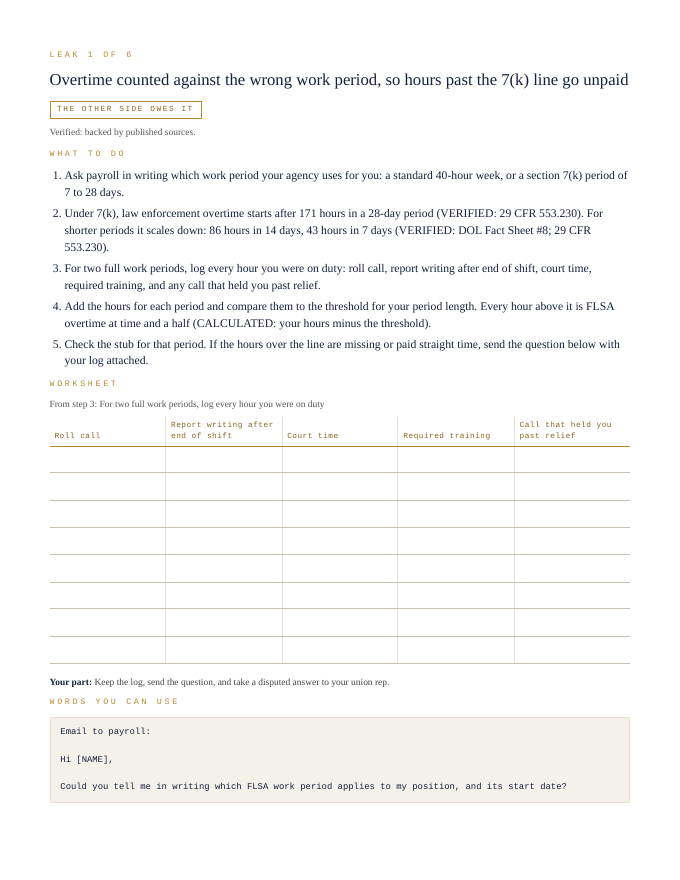
Overtime counted against the wrong work period, so hours past the 7(k) line go unpaid
The other side owes it- Ask payroll in writing which work period your agency uses for you: a standard 40-hour week, or a section 7(k) period of 7 to 28 days.
- Under 7(k), law enforcement overtime starts after 171 hours in a 28-day period (VERIFIED: 29 CFR 553.230). For shorter periods it scales down: 86 hours in 14 days, 43 hours in 7 days (VERIFIED: DOL Fact Sheet #8; 29 CFR 553.230).
- For two full work periods, log every hour you were on duty: roll call, report writing after end of shift, court time, required training, and any call that held you past relief.
- Add the hours for each period and compare them to the threshold for your period length. Every hour above it is FLSA overtime at time and a half (CALCULATED: your hours minus the threshold).
- Check the stub for that period. If the hours over the line are missing or paid straight time, send the question below with your log attached.
Your part: Keep the log, send the question, and take a disputed answer to your union rep.
Email to payroll:


Hi [NAME],

Could you tell me in writing which FLSA work period applies to my position, and its start date?

For the period [DATES], my log (attached) shows [HOURS] hours on duty, including [ROLL CALL / COURT / REPORTS]. My stub shows [HOURS] paid at overtime. Can you show me how overtime was figured for that period?

Thank you,
[YOUR NAME] | Badge [#] | [PHONE]
Write your on-duty hours on the calendar the same day, every day, and add them up when each work period closes.
What this kit can't decide for you: Whether a given hour counts as work, and whether your agency set up its 7(k) period correctly, is for payroll, your union or the Wage and Hour Division to decide. Your contract may pay more than the federal floor.
That's 1 of 6. The other 5 come the same way in the kit: steps, words to send, a habit to keep each one closed.
Opens secure checkout. Instant download after payment. 30 days to ask for a refund — refund policy · terms
What people in this work look up
When police officers and detectives go looking for answers, they search things like “police overtime”, “police pension”, “police officer salary” and “police off duty pay”. Those searches turn up forms, averages and other people's numbers. This kit starts from your own records instead: the 6 places money leaks in this work, where to look first and the words to send to close each one.
What you get for each leak
- Numbered steps to close each leak
- Your part, spelled out
- Words you can use: letters and scripts, ready to send (fill in the brackets)
- A habit that keeps each leak from coming back
- An honest line on what the kit can't decide for you
A page from the kit
Questions people ask
Overtime counted against the wrong work period, so hours past the 7(k) line go unpaid: where do I start?
Start here: Ask payroll in writing which work period your agency uses for you: a standard 40-hour week, or a section 7(k) period of 7 to 28 days. To keep it from coming back: Write your on-duty hours on the calendar the same day, every day, and add them up when each work period closes.
Comp time piling up near the cap and never used or paid: where do I start?
Start here: Pull your latest comp time balance from your stub or timekeeping system. To keep it from coming back: Check your comp balance on every stub. Put in a time-off request the month it passes half of the cap.
Special detail and off-duty jobs paid with fees or rates nobody checks: where do I start?
Start here: List every detail or off-duty job you worked in the last 12 months: date, hours, who hired you, who paid you, and the rate. To keep it from coming back: Log every detail the day you work it, with who paid you. Match the log to your stubs and tax forms every quarter.
What it can't decide for you
This kit works from your own records. It doesn't give legal, tax, licensing or financial advice, and it never tells you what to charge. Where a CPA, attorney, insurer or state board makes the call, the kit says so and gets your records ready for them.
13-page PDF · instant download after payment · Code VYR-KIT-POLICE-01
Opens secure checkout. Instant download after payment. 30 days to ask for a refund — refund policy · terms
Next step
- Run your free LeakReceipts check — it reads your own receipts and records and shows where money is leaking out, line by line.
- TrueNET — the whole-picture money truth: what you actually keep after every cost, across everything you earn and spend.
Use Jobber or Housecall Pro? Run the free leak check — it reads your job export in your browser and shows the money leaks the software doesn't flag. Nothing is uploaded.