The Salaried Professionals Fix Kit
Built for salaried professionals (analysts, PMs, scientists, librarians).
A salary feels like a fixed number, so salaried people rarely check it. The leaks I see are a salary that does not meet the federal exemption, deductions an exempt employee should not see, a job whose duties do not fit the label, and raises never asked for with real data. Each leak below is checked against your own offer letter, stubs and job description. This kit finds where the money leaks in your own work and gives you the steps and the words to close each one.
Opens secure checkout. Instant download after payment. 30 days to ask for a refund — refund policy · terms
The 7 leaks it covers
3 you can close it · 2 the other side owes it · 2 a pro decides
- Paid a salary with no overtime, but the salary or the deductions do not fit the exemptionWhere to look first: Find your weekly salary. The federal minimum salary for the white-collar overtime exemptions is $684 a week ($35,568 a year) (VERIFIED: Polsinelli on the May 13 2026 DOL rescission). Below that, the federal white-collar exemption does not apply.Keep it from coming back: Read every stub for salary deductions, and keep your own record of weekly hours.The other side owes it
- Exempt label on routine work the rules do not treat as professionalWhere to look first: Write down what you actually spend most of your time doing in a typical week.Keep it from coming back: Keep your job description and update your own duties list each year.A pro decides
- Raise never asked for with your own evidenceWhere to look first: List your results since your last raise: projects, numbers, savings, new duties.Keep it from coming back: Keep a running list of results and send the ask a month before budgets are set.You can close it
- Job offers compared by salary aloneWhere to look first: For each offer and your current job, write: salary, bonus target and how it is decided, retirement match, health premium you pay, paid time off, commute cost, remote days.Keep it from coming back: Keep every offer in one sheet with the same rows.You can close it
- Retirement match and benefits set once and never re-checkedWhere to look first: Find your plan's match formula in the plan documents or portal.Keep it from coming back: Re-check every January and after every raise.You can close it
- Overtime hours worked with no record kept, in case you are non-exemptWhere to look first: For two weeks, write down the clock-in and clock-out times on your stub next to the times you actually started and stopped working: evening email, weekend reports, on-call checks.Keep it from coming back: Clock in before the first task and clock out after the last one. Log any break that gets interrupted, the same day.The other side owes it
- No tax set aside from money paid with nothing withheldWhere to look first: Write down which of your pay arrives with no tax taken out: side income from consulting, freelancing or selling.Keep it from coming back: Move the set-aside the day each payment lands. Put every estimated-tax date your preparer gives you on the calendar in January.A pro decides
Free: one full leak from this kit
No sign-up, no email. Here is leak 1 of 7 exactly as it appears in the kit, so you can see what you get before you buy.
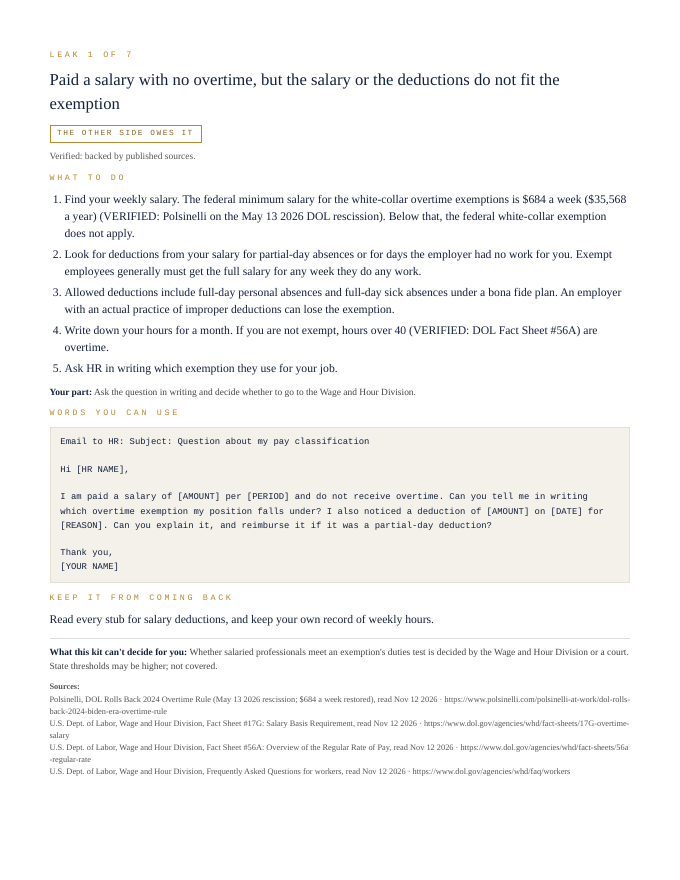
Paid a salary with no overtime, but the salary or the deductions do not fit the exemption
The other side owes it- Find your weekly salary. The federal minimum salary for the white-collar overtime exemptions is $684 a week ($35,568 a year) (VERIFIED: Polsinelli on the May 13 2026 DOL rescission). Below that, the federal white-collar exemption does not apply.
- Look for deductions from your salary for partial-day absences or for days the employer had no work for you. Exempt employees generally must get the full salary for any week they do any work.
- Allowed deductions include full-day personal absences and full-day sick absences under a bona fide plan. An employer with an actual practice of improper deductions can lose the exemption.
- Write down your hours for a month. If you are not exempt, hours over 40 (VERIFIED: DOL Fact Sheet #56A) are overtime.
- Ask HR in writing which exemption they use for your job.
Your part: Ask the question in writing and decide whether to go to the Wage and Hour Division.
Email to HR:

Subject: Question about my pay classification

Hi [HR NAME],

I am paid a salary of [AMOUNT] per [PERIOD] and do not receive overtime. Can you tell me in writing which overtime exemption my position falls under? I also noticed a deduction of [AMOUNT] on [DATE] for [REASON]. Can you explain it, and reimburse it if it was a partial-day deduction?

Thank you,
[YOUR NAME]
Read every stub for salary deductions, and keep your own record of weekly hours.
What this kit can't decide for you: Whether salaried professionals meet an exemption's duties test is decided by the Wage and Hour Division or a court. State thresholds may be higher; not covered.
That's 1 of 7. The other 6 come the same way in the kit: steps, words to send, a habit to keep each one closed.
Opens secure checkout. Instant download after payment. 30 days to ask for a refund — refund policy · terms
What people in this work look up
When salaried professionals (analysts, PMs, scientists, librarians) go looking for answers, they search things like “salary negotiation”, “exempt employee overtime”, “salary raise” and “how to ask for a raise”. Those searches turn up forms, averages and other people's numbers. This kit starts from your own records instead: the 7 places money leaks in this work, where to look first and the words to send to close each one.
What you get for each leak
- Numbered steps to close each leak
- Your part, spelled out
- Words you can use: letters and scripts, ready to send (fill in the brackets)
- A habit that keeps each leak from coming back
- An honest line on what the kit can't decide for you
A page from the kit
Questions people ask
Paid a salary with no overtime, but the salary or the deductions do not fit the exemption: where do I start?
Start here: Find your weekly salary. The federal minimum salary for the white-collar overtime exemptions is $684 a week ($35,568 a year) (VERIFIED: Polsinelli on the May 13 2026 DOL rescission). Below that, the federal white-collar exemption does not apply. To keep it from coming back: Read every stub for salary deductions, and keep your own record of weekly hours.
Exempt label on routine work the rules do not treat as professional: where do I start?
Start here: Write down what you actually spend most of your time doing in a typical week. To keep it from coming back: Keep your job description and update your own duties list each year.
Raise never asked for with your own evidence: where do I start?
Start here: List your results since your last raise: projects, numbers, savings, new duties. To keep it from coming back: Keep a running list of results and send the ask a month before budgets are set.
What it can't decide for you
This kit works from your own records. It doesn't give legal, tax, licensing or financial advice, and it never tells you what to charge. Where a CPA, attorney, insurer or state board makes the call, the kit says so and gets your records ready for them.
13-page PDF · instant download after payment · Code VYR-KIT-SALARIED-01
Opens secure checkout. Instant download after payment. 30 days to ask for a refund — refund policy · terms
Next step
- Run your free LeakReceipts check — it reads your own receipts and records and shows where money is leaking out, line by line.
- TrueNET — the whole-picture money truth: what you actually keep after every cost, across everything you earn and spend.
Use Jobber or Housecall Pro? Run the free leak check — it reads your job export in your browser and shows the money leaks the software doesn't flag. Nothing is uploaded.