The Commercial Specialty Subcontractors Fix Kit
Built for commercial specialty subcontractors on private and federal jobs.
If you're a specialty subcontractor — electrical, mechanical, plumbing, drywall, whatever the trade — sending pay applications up to a general contractor, your biggest leak usually isn't a bad rate. This kit finds where the money leaks in your own work and gives you the steps and the words to close each one.
Opens secure checkout. Instant download after payment. 30 days to ask for a refund — refund policy · terms
The 7 leaks it covers
6 the other side owes it · 1 a pro decides
- Federal job payment-bond (Miller Act) notice or suit deadline missedWhere to look first: Write down who your contract is with on this federal job: the prime itself, or a sub of the prime.Keep it from coming back: On every federal job, log your last day of work the day it happens and calendar day 90 and one year the same day. Ask for the payment bond copy at the start of the job.The other side owes it
- GC paid you late after the owner paid them — state prompt-pay windowWhere to look first: For every pay application, record the date you invoiced and the date the money landed.Keep it from coming back: Before signing, read the payment clause ('if' vs 'when') and note your state's prompt-pay window for the job type. Ask the GC to tell you when the owner pays.The other side owes it
- Federal job: GC paid you more than 7 days after the government paid themWhere to look first: On every federal pay application, write down the date you submitted it and the date your money actually landed.Keep it from coming back: On federal jobs, ask the GC at the start to tell you each time the government pays for your work. Log submit and paid dates on every pay app.The other side owes it
- Extra work on a federal job done on a verbal order with no written change noticeWhere to look first: Today, list every piece of work on this job that someone told you to do that was not in your scope: what, who said it, the date it started.Keep it from coming back: Read the changes/notice clause of every subcontract before mobilizing and put its deadline on your calendar. Rule on site: verbal direction = written notice the same day.The other side owes it
- Retainage held past your state's release deadline or above its capWhere to look first: For each job, write down: the state, public or private, the retainage percent held, the dollar amount held to date, and the date the job reached substantial completion or acceptance.Keep it from coming back: Before signing, note the retainage percent and release terms in the subcontract and compare them to the state statute. Calendar the release date the day you hit substantial completion.The other side owes it
- State mechanics-lien preliminary notice or filing deadline missedWhere to look first: For every job, write down the state, the owner's name and address, your first day on the job and your last day.Keep it from coming back: Make the preliminary notice part of mobilizing on every job. Calendar the lien deadline from your last day of work, every time.The other side owes it
- Self-employment tax not set aside from pay-app and retainage moneyWhere to look first: This one is not a leak anyone owes you back. It is the share of profit that goes to self-employment tax before the money is really yours. Each time a pay application or retainage payment lands, write down the date and amount in one list.Keep it from coming back: Set the money aside the day it lands, not at tax time. Put the quarterly estimate dates on your calendar for the year.A pro decides
Free: one full leak from this kit
No sign-up, no email. Here is leak 1 of 7 exactly as it appears in the kit, so you can see what you get before you buy.
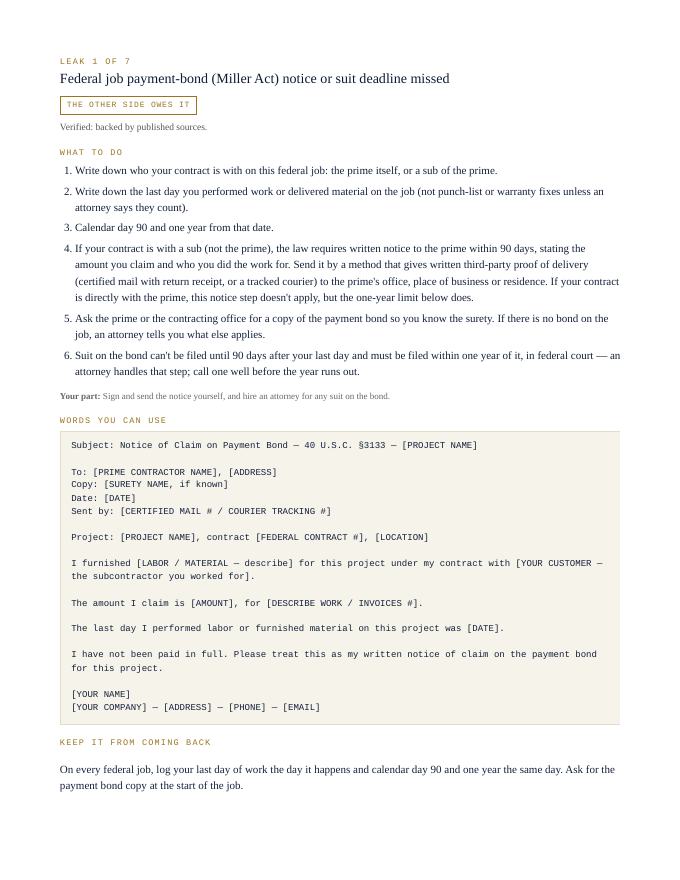
Federal job payment-bond (Miller Act) notice or suit deadline missed
The other side owes it- Write down who your contract is with on this federal job: the prime itself, or a sub of the prime.
- Write down the last day you performed work or delivered material on the job (not punch-list or warranty fixes unless an attorney says they count).
- Calendar day 90 and one year from that date.
- If your contract is with a sub (not the prime), the law requires written notice to the prime within 90 days, stating the amount you claim and who you did the work for. Send it by a method that gives written third-party proof of delivery (certified mail with return receipt, or a tracked courier) to the prime's office, place of business or residence. If your contract is directly with the prime, this notice step doesn't apply, but the one-year limit below does.
- Ask the prime or the contracting office for a copy of the payment bond so you know the surety. If there is no bond on the job, an attorney tells you what else applies.
- Suit on the bond can't be filed until 90 days after your last day and must be filed within one year of it, in federal court — an attorney handles that step; call one well before the year runs out.
Your part: Sign and send the notice yourself, and hire an attorney for any suit on the bond.
Subject: Notice of Claim on Payment Bond — 40 U.S.C. §3133 — [PROJECT NAME]

To: [PRIME CONTRACTOR NAME], [ADDRESS]
Copy: [SURETY NAME, if known]
Date: [DATE]
Sent by: [CERTIFIED MAIL # / COURIER TRACKING #]

Project: [PROJECT NAME], contract [FEDERAL CONTRACT #], [LOCATION]

I furnished [LABOR / MATERIAL — describe] for this project under my contract with [YOUR CUSTOMER — the subcontractor you worked for].

The amount I claim is [AMOUNT], for [DESCRIBE WORK / INVOICES #].

The last day I performed labor or furnished material on this project was [DATE].

I have not been paid in full. Please treat this as my written notice of claim on the payment bond for this project.

[YOUR NAME]
[YOUR COMPANY] — [ADDRESS] — [PHONE] — [EMAIL]
On every federal job, log your last day of work the day it happens and calendar day 90 and one year the same day. Ask for the payment bond copy at the start of the job.
What this kit can't decide for you: Whether a claim is valid, which date counts as the last day, the exact service method the statute requires, and filing suit are an attorney's call. The 90-day notice applies to claimants without a direct contract with the prime; first-tier subs skip notice but still face the one-year suit limit. We never file.
That's 1 of 7. The other 6 come the same way in the kit: steps, words to send, a habit to keep each one closed.
Opens secure checkout. Instant download after payment. 30 days to ask for a refund — refund policy · terms
What people in this work look up
When commercial specialty subcontractors go looking for answers, they search things like “pay application”, “mechanics lien”, “retainage” and “aia g702”. Those searches turn up forms, averages and other people's numbers. This kit starts from your own records instead: the 7 places money leaks in this work, where to look first and the words to send to close each one.
What you get for each leak
- Numbered steps to close each leak
- Your part, spelled out
- Words you can use: letters and scripts, ready to send (fill in the brackets)
- A habit that keeps each leak from coming back
- An honest line on what the kit can't decide for you
A page from the kit
Questions people ask
How long can a GC hold retainage?
States set release deadlines and caps. The kit shows how to check your state's rules against what's being held.
What if the GC pays me late after the owner paid them?
Many states have a prompt-pay window, and federal jobs have their own clock. The kit shows how to document the dates on every pay application.
When do I need to file a mechanics lien notice?
Preliminary notice and filing deadlines vary by state, and missing them can cost your right. The kit lists what to calendar.
What it can't decide for you
This kit works from your own records. It doesn't give legal, tax, licensing or financial advice, and it never tells you what to charge. Where a CPA, attorney, insurer or state board makes the call, the kit says so and gets your records ready for them.
14-page PDF · instant download after payment · Code VYR-KIT-PAYTON-01
Opens secure checkout. Instant download after payment. 30 days to ask for a refund — refund policy · terms
Use Jobber or Housecall Pro? Run the free leak check — it reads your job export in your browser and shows the money leaks the software doesn't flag. Nothing is uploaded.