The Electrical Subcontractors Fix Kit
Built for electrical subcontractors and electrical contractors.
The two companies that dominate electrical contracting nationally got there by opposite ownership paths — one sold equity to the crew, one bought up established shops — but they share one discipline underneath: every hour of directed field work gets turned into paper before the invoice goes out. This kit finds where the money leaks in your own work and gives you the steps and the words to close each one.
Opens secure checkout. Instant download after payment. 30 days to ask for a refund — refund policy · terms
The 7 leaks it covers
2 you can close it · 4 the other side owes it · 1 a pro decides
- Directed extra work done on a field ticket with no written change orderWhere to look first: The field ticket proves the work happened. It doesn't prove anyone agreed to pay for it.Keep it from coming back: No directed extra work without a same-day email notice. Ticket signed by an authorized person before the crew leaves site.You can close it
- Growth capped by one qualifying master electrician's licenseWhere to look first: Not a dollar leak - a limit on how far you can grow. Count how many licensed masters your company has, and which one is your qualifier on file with the state.Keep it from coming back: Check the board's qualifier rule before bidding work that needs more crews or a new location.You can close it
- Retainage held above the cap or past the point your scope is completeWhere to look first: On every pay application, write down the percentage and dollar amount held back.Keep it from coming back: Before signing, note the retainage percentage and release terms. Send closeout documents the day your scope is done.The other side owes it
- Paid by the GC long after the GC was paid; prompt-pay clock never checkedWhere to look first: For each pay application, write down the date you billed and the date your money landed.Keep it from coming back: Before signing a subcontract, find the payment clause and note whether it says 'if' or 'when' the owner pays. Ask for the owner-paid date with every pay app.The other side owes it
- Federal job, no contract with the prime: Miller Act 90-day notice window missedWhere to look first: Check who your contract is with. If it's with a sub and not the prime, the Miller Act notice applies to you.Keep it from coming back: On every federal job, record who you contract with and your last day on site, and set day-60 and day-90 reminders the moment you leave.The other side owes it
- Claim notice deadline (AIA 21-day / FAR 30-day) not calendared when the change happensWhere to look first: The day something happens that will cost you time or money (a directed change, a delay, a hidden condition), write the date down and start the clock.Keep it from coming back: Log every directed change or delay the same day, with the notice deadline next to it.The other side owes it
- Owner doesn't know how entity structure changes your self-employment tax pictureWhere to look first: Not a leak - a fact your CPA needs to look at. Find out how your business is set up for tax: sole proprietor, partnership, LLC, or S-corp. Your last return shows it.Keep it from coming back: Review your entity setup with your CPA once a year, before year-end.A pro decides
Free: one full leak from this kit
No sign-up, no email. Here is leak 1 of 7 exactly as it appears in the kit, so you can see what you get before you buy.
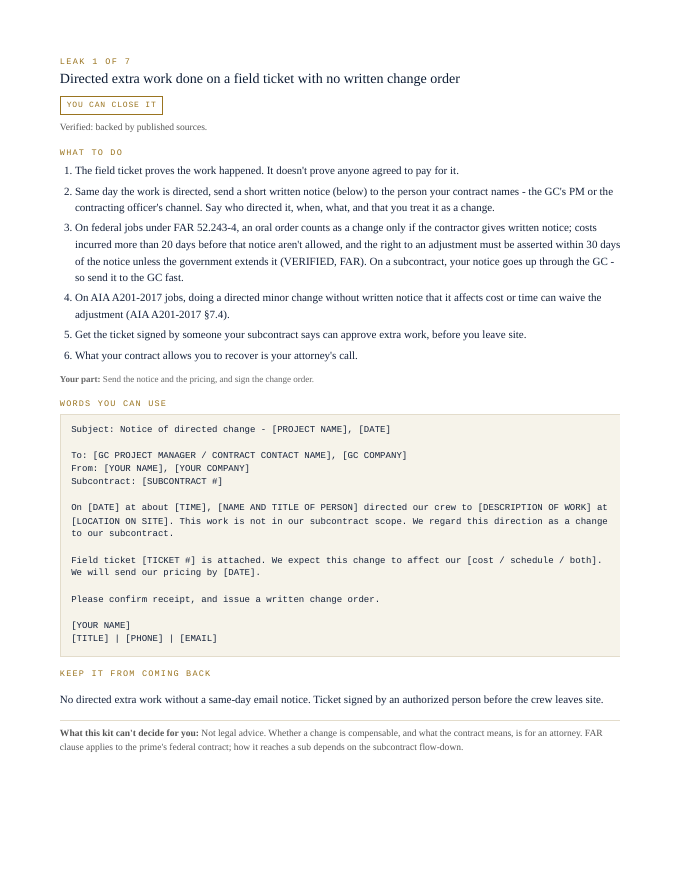
Directed extra work done on a field ticket with no written change order
You can close it- The field ticket proves the work happened. It doesn't prove anyone agreed to pay for it.
- Same day the work is directed, send a short written notice (below) to the person your contract names - the GC's PM or the contracting officer's channel. Say who directed it, when, what, and that you treat it as a change.
- On federal jobs under FAR 52.243-4, an oral order counts as a change only if the contractor gives written notice; costs incurred more than 20 days before that notice aren't allowed, and the right to an adjustment must be asserted within 30 days of the notice unless the government extends it (VERIFIED, FAR). On a subcontract, your notice goes up through the GC - so send it to the GC fast.
- On AIA A201-2017 jobs, doing a directed minor change without written notice that it affects cost or time can waive the adjustment (AIA A201-2017 §7.4).
- Get the ticket signed by someone your subcontract says can approve extra work, before you leave site.
- What your contract allows you to recover is your attorney's call.
Your part: Send the notice and the pricing, and sign the change order.
Subject: Notice of directed change - [PROJECT NAME], [DATE]

To: [GC PROJECT MANAGER / CONTRACT CONTACT NAME], [GC COMPANY]
From: [YOUR NAME], [YOUR COMPANY]
Subcontract: [SUBCONTRACT #]

On [DATE] at about [TIME], [NAME AND TITLE OF PERSON] directed our crew to [DESCRIPTION OF WORK] at [LOCATION ON SITE]. This work is not in our subcontract scope. We regard this direction as a change to our subcontract.

Field ticket [TICKET #] is attached. We expect this change to affect our [cost / schedule / both]. We will send our pricing by [DATE].

Please confirm receipt, and issue a written change order.

[YOUR NAME]
[TITLE] | [PHONE] | [EMAIL]
No directed extra work without a same-day email notice. Ticket signed by an authorized person before the crew leaves site.
What this kit can't decide for you: Not legal advice. Whether a change is compensable, and what the contract means, is for an attorney. FAR clause applies to the prime's federal contract; how it reaches a sub depends on the subcontract flow-down.
That's 1 of 7. The other 6 come the same way in the kit: steps, words to send, a habit to keep each one closed.
Opens secure checkout. Instant download after payment. 30 days to ask for a refund — refund policy · terms
What people in this work look up
When electrical subcontractors go looking for answers, they search things like “pay application”, “retainage”, “electrical subcontractor” and “electrical estimating”. Those searches turn up forms, averages and other people's numbers. This kit starts from your own records instead: the 7 places money leaks in this work, where to look first and the words to send to close each one.
What you get for each leak
- Numbered steps to close each leak
- Your part, spelled out
- Words you can use: letters and scripts, ready to send (fill in the brackets)
- A habit that keeps each leak from coming back
- An honest line on what the kit can't decide for you
A page from the kit
Questions people ask
What if the GC asks for extra work on a field ticket?
Directed extra work with no written change order is the first leak in the kit. It shows how to turn the ticket into a change order.
What notice deadlines apply to a change?
Contract claim notice windows like AIA 21-day or FAR 30-day need to be on the calendar when the change happens. The kit shows how.
Can a GC hold retainage after my scope is done?
Retainage held above the cap or past completion is a leak the kit covers, with the words to send.
What it can't decide for you
This kit works from your own records. It doesn't give legal, tax, licensing or financial advice, and it never tells you what to charge. Where a CPA, attorney, insurer or state board makes the call, the kit says so and gets your records ready for them.
11-page PDF · instant download after payment · Code VYR-KIT-CIRCUIT-01
Opens secure checkout. Instant download after payment. 30 days to ask for a refund — refund policy · terms
Use Jobber or Housecall Pro? Run the free leak check — it reads your job export in your browser and shows the money leaks the software doesn't flag. Nothing is uploaded.