The Freight Brokerage Fix Kit
Built for freight brokers and freight broker agents.
A broker owns no trucks. The whole business is the spread between what the shipper pays and what the carrier is paid, and that spread gets squeezed from both sides at once: overpaying a carrier on an extra nobody verified, and underbilling the shipper on one nobody documented. This kit finds where the money leaks in your own work and gives you the steps and the words to close each one.
Opens secure checkout. Instant download after payment. 30 days to ask for a refund — refund policy · terms
The 7 leaks it covers
3 you can close it · 3 the other side owes it · 1 a pro decides
- Planning around a broker transparency rule that isn't finalWhere to look first: Follow the rule that exists today: brokers must keep a record of each brokered transaction, and the parties to it can ask to review it (49 CFR 371.3).Keep it from coming back: Keep every load's transaction record complete on the day the load closes, so any request can be answered the same day.You can close it
- Tendering loads without verifying the carrier's identity, authority and insuranceWhere to look first: Before you tender, look the carrier up by its USDOT number on FMCSA SAFER (safer.fmcsa.dot.gov) - Company Snapshot. Check authority is active and insurance is on file.Keep it from coming back: No load is tendered until the SAFER snapshot is saved and the carrier is reached at the SAFER phone number.You can close it
- Broker bond or trust running close to the $75,000 line with no replenishment planWhere to look first: Confirm what you have on file with FMCSA: a surety bond (BMC-84) or a trust (BMC-85).Keep it from coming back: Ask your provider for a balance and open-claims statement every month, and keep the replenishment cash identified ahead of time.You can close it
- Seeing gross spread per load but not net margin after quick-pay, fees and claimsWhere to look first: For each load, write down: shipper billed (including accessorials), carrier paid (including accessorials), quick-pay fee kept, cost to fund early pay, load board or software fees for that load, and any claim paid.Keep it from coming back: Close each load with its net figure, not just its spread, and review net by shipper every month.The other side owes it
- Quick-pay or factoring cost not tracked against margin load by loadWhere to look first: For every load where you paid a carrier early, write down: shipper billed, carrier paid, quick-pay fee you kept, the date you paid the carrier, and the date the shipper paid you.Keep it from coming back: Put the quick-pay fee and terms on every rate confirmation, and review net per shipper monthly.The other side owes it
- Cargo claim exposure not set out in the shipper agreement or passed to the carrierWhere to look first: Read the liability section of each shipper agreement: who is liable for loss or damage, up to what amount, and how claims are handled.Keep it from coming back: Before you tender a load, have the carrier's cargo certificate on file and a liability clause in both the shipper and carrier agreements.The other side owes it
- Self-employment tax not set aside from untaxed business/contract incomeWhere to look first: Open a separate savings account used only for tax.Keep it from coming back: Move the set-aside the same day each payment lands. Put every estimated-tax date your CPA gives you on the calendar at the start of the year.A pro decides
Free: one full leak from this kit
No sign-up, no email. Here is leak 1 of 7 exactly as it appears in the kit, so you can see what you get before you buy.
Planning around a broker transparency rule that isn't final
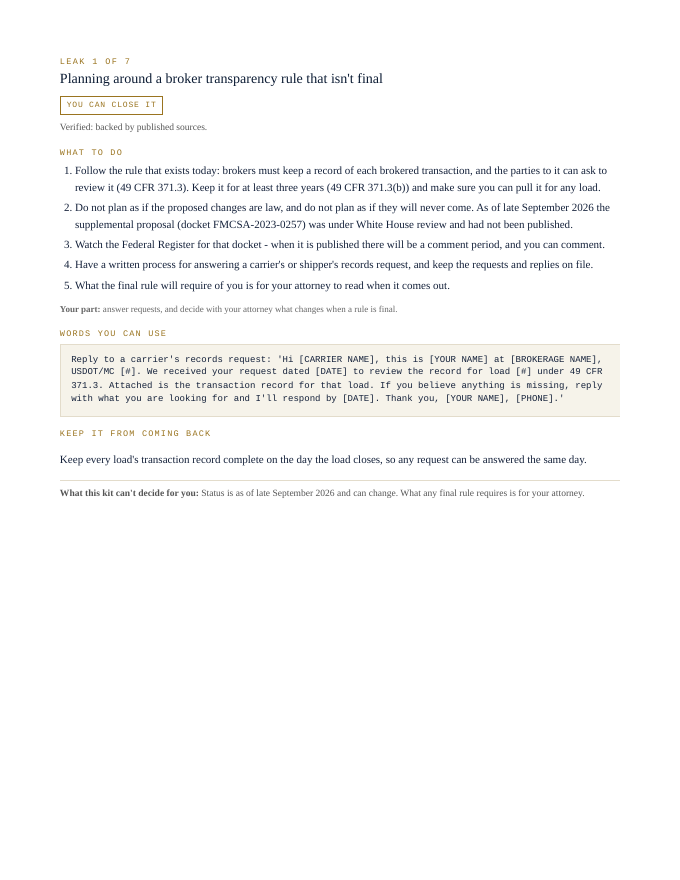
You can close it- Follow the rule that exists today: brokers must keep a record of each brokered transaction, and the parties to it can ask to review it (49 CFR 371.3). Keep it for at least three years (49 CFR 371.3(b)) and make sure you can pull it for any load.
- Do not plan as if the proposed changes are law, and do not plan as if they will never come. As of late September 2026 the supplemental proposal (docket FMCSA-2023-0257) was under White House review and had not been published.
- Watch the Federal Register for that docket - when it is published there will be a comment period, and you can comment.
- Have a written process for answering a carrier's or shipper's records request, and keep the requests and replies on file.
- What the final rule will require of you is for your attorney to read when it comes out.
Your part: Answer requests, and decide with your attorney what changes when a rule is final.
Reply to a carrier's records request: 'Hi [CARRIER NAME], this is [YOUR NAME] at [BROKERAGE NAME], USDOT/MC [#]. We received your request dated [DATE] to review the record for load [#] under 49 CFR 371.3. Attached is the transaction record for that load. If you believe anything is missing, reply with what you are looking for and I'll respond by [DATE]. Thank you, [YOUR NAME], [PHONE].'
Keep every load's transaction record complete on the day the load closes, so any request can be answered the same day.
What this kit can't decide for you: Status is as of late September 2026 and can change. What any final rule requires is for your attorney.
That's 1 of 7. The other 6 come the same way in the kit: steps, words to send, a habit to keep each one closed.
Opens secure checkout. Instant download after payment. 30 days to ask for a refund — refund policy · terms
What people in this work look up
When freight brokers and agents go looking for answers, they search things like “freight broker license”, “double brokering”, “freight broker bond”, “freight broker business” and “carrier vetting”. Those searches turn up forms, averages and other people's numbers. This kit starts from your own records instead: the 7 places money leaks in this work, where to look first and the words to send to close each one.
What you get for each leak
- Numbered steps to close each leak
- Your part, spelled out
- Words you can use: letters and scripts, ready to send (fill in the brackets)
- A habit that keeps each leak from coming back
- An honest line on what the kit can't decide for you
A page from the kit
Questions people ask
What's my real margin per load?
Net after quick-pay, fees and claims, not gross spread. The kit shows how.
How do I vet a carrier?
Verify identity, authority and insurance before tendering. The kit shows the checks.
Is the broker transparency rule final?
Planning around a rule that isn't final is a leak the kit covers.
What it can't decide for you
This kit works from your own records. It doesn't give legal, tax, licensing or financial advice, and it never tells you what to charge. Where a CPA, attorney, insurer or state board makes the call, the kit says so and gets your records ready for them.
11-page PDF · instant download after payment · Code VYR-KIT-BRK-01
Opens secure checkout. Instant download after payment. 30 days to ask for a refund — refund policy · terms
Use Jobber or Housecall Pro? Run the free leak check — it reads your job export in your browser and shows the money leaks the software doesn't flag. Nothing is uploaded.