The Kitchen Exhaust Cleaning Fix Kit
Built for kitchen exhaust and restaurant hood cleaning companies.
Fire code requires a commercial kitchen's entire exhaust system — hood, duct, and fan — to be cleaned to bare metal, and requires access panels along the duct so the whole run can actually be reached. This kit finds where the money leaks in your own work and gives you the steps and the words to close each one.
Opens secure checkout. Instant download after payment. 30 days to ask for a refund — refund policy · terms
The 7 leaks it covers
6 you can close it · 1 a pro decides
- Assuming one national cleaning schedule for every customerWhere to look first: For each customer, find out what cooking they do and which fire code their city or state uses.Keep it from coming back: Record each new customer's required interval and insurer requirement at the first job.You can close it
- Customer doesn't see why the full code-scope price is worth payingWhere to look first: When a customer pushes back on price, explain the two people the building answers to: the local fire official and their insurer.Keep it from coming back: Hand every new customer a sample report with the quote so they see what they're paying for.You can close it
- Cleaning only what's reachable when the code requires hood to fanWhere to look first: Survey before you bid: walk the full duct run from hood to fan and note every section you can't reach.Keep it from coming back: Do a hood-to-fan walk-through on every new account and price unreachable sections before the first cleaning.You can close it
- Access panel left in the duct — a documented fire-cause riskWhere to look first: Number every panel you remove and write the count on the job sheet.Keep it from coming back: No job closes without the panel count matching and photos saved.You can close it
- Installing missing access panels for free or skipping themWhere to look first: When you find a duct run without access, stop and price it before doing it.Keep it from coming back: Add a separately priced access-panel line to every quote template.You can close it
- Certificate says 'fully cleaned' when parts weren't reachedWhere to look first: After every job, list every section you couldn't reach or didn't clean in the written report to the owner.Keep it from coming back: Make 'not cleaned / inaccessible' a required field on every report.You can close it
- Self-employment tax not budgeted through the yearWhere to look first: Nothing recovers this one - plan for it. Set aside a share of every customer payment in a separate tax account. Your CPA tells you what share.Keep it from coming back: Move the set-aside on every payment day.A pro decides
Free: one full leak from this kit
No sign-up, no email. Here is leak 1 of 7 exactly as it appears in the kit, so you can see what you get before you buy.
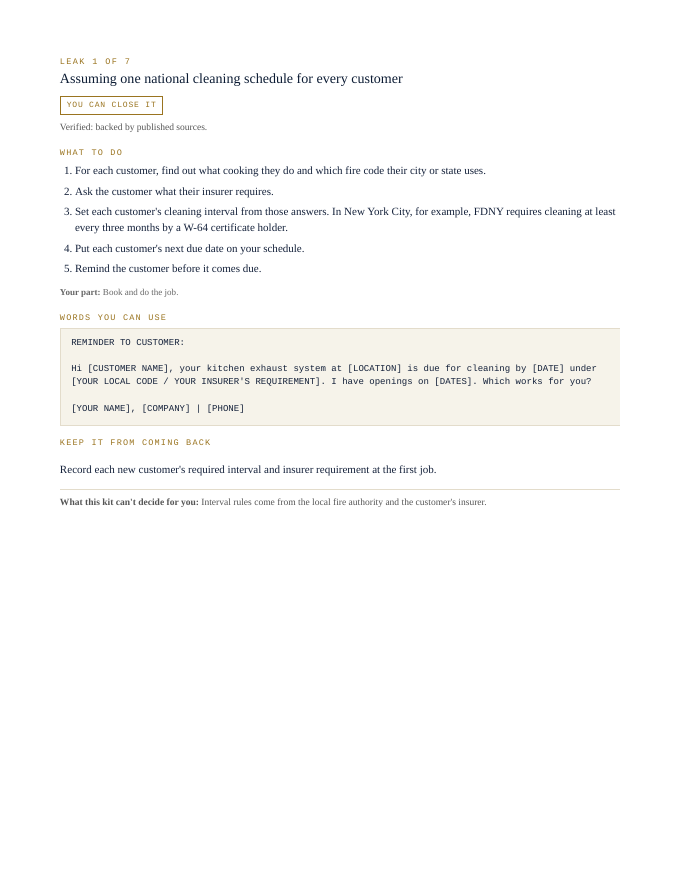
Assuming one national cleaning schedule for every customer
You can close it- For each customer, find out what cooking they do and which fire code their city or state uses.
- Ask the customer what their insurer requires.
- Set each customer's cleaning interval from those answers. In New York City, for example, FDNY requires cleaning at least every three months by a W-64 certificate holder.
- Put each customer's next due date on your schedule.
- Remind the customer before it comes due.
Your part: Book and do the job.
REMINDER TO CUSTOMER:

Hi [CUSTOMER NAME], your kitchen exhaust system at [LOCATION] is due for cleaning by [DATE] under [YOUR LOCAL CODE / YOUR INSURER'S REQUIREMENT]. I have openings on [DATES]. Which works for you?

[YOUR NAME], [COMPANY] | [PHONE]
Record each new customer's required interval and insurer requirement at the first job.
What this kit can't decide for you: Interval rules come from the local fire authority and the customer's insurer.
That's 1 of 7. The other 6 come the same way in the kit: steps, words to send, a habit to keep each one closed.
Opens secure checkout. Instant download after payment. 30 days to ask for a refund — refund policy · terms
What people in this work look up
When kitchen exhaust cleaning companies go looking for answers, they search things like “hood cleaning certification”, “hood cleaning business” and “hood cleaning prices”. Those searches turn up forms, averages and other people's numbers. This kit starts from your own records instead: the 7 places money leaks in this work, where to look first and the words to send to close each one.
What you get for each leak
- Numbered steps to close each leak
- Your part, spelled out
- Words you can use: letters and scripts, ready to send (fill in the brackets)
- A habit that keeps each leak from coming back
- An honest line on what the kit can't decide for you
A page from the kit
Questions people ask
How often should a kitchen hood be cleaned?
Not on one national schedule. The kit shows how to set each customer's frequency from the code and the kind of cooking.
How should I price hood cleaning?
Price the full code scope, hood to fan, and show the customer why it's worth paying. The kit has the words to use.
What should my hood cleaning certificate say?
Only what was actually reached. Saying 'fully cleaned' when parts weren't is a risk the kit helps you avoid.
What it can't decide for you
This kit works from your own records. It doesn't give legal, tax, licensing or financial advice, and it never tells you what to charge. Where a CPA, attorney, insurer or state board makes the call, the kit says so and gets your records ready for them.
11-page PDF · instant download after payment · Code VYR-KIT-HOOD-01
Opens secure checkout. Instant download after payment. 30 days to ask for a refund — refund policy · terms
Use Jobber or Housecall Pro? Run the free leak check — it reads your job export in your browser and shows the money leaks the software doesn't flag. Nothing is uploaded.