The Small Fleet Carriers Fix Kit
Built for small trucking companies running 2 to 20 trucks.
Every winner in this fleet owner's business knows a number nobody else in the truck bothered to write down. This kit finds where the money leaks in your own work and gives you the steps and the words to close each one.
Opens secure checkout. Instant download after payment. 30 days to ask for a refund — refund policy · terms
The 6 leaks it covers
4 you can close it · 1 the other side owes it · 1 a pro decides
- Fleet doesn't know its own true cost per mile, so it can't judge a rate or an accessorialWhere to look first: Pull the last three to six months: every cost (fuel, insurance, truck and trailer payments, repairs, tires, permits, driver pay, everything) and total miles, loaded and empty.Keep it from coming back: Update your cost per mile every month, and check every load against it before accepting.You can close it
- Fuel surcharge figured on a high base price, a high MPG, or an old week's diesel priceWhere to look first: The money moves before you accept. Know your cost per mile and your truck's real miles per gallon from your own fuel records.Keep it from coming back: Get the base price, MPG and EIA week in writing before you accept any rate with a surcharge. Re-check all three at every contract renewal.You can close it
- Paperwork habits don't scale from one truck to a 2–20 truck fleetWhere to look first: Write one load-paperwork standard for every truck: signed rate con, BOL, in and out times at every stop, photos of the load secured, and the POD — all in one folder per load.Keep it from coming back: When you add a truck, add it to the same paperwork standard on day one.You can close it
- Detention can't be proven because arrival/departure times aren't written downWhere to look first: If you run flatbed, detention is rare — but when it happens, the times are the only proof. Before you accept, check the rate con for detention terms: free time, hourly amount, and how and when to notify the broker.Keep it from coming back: No load rolls without detention terms on the rate con, and no driver leaves a stop without writing the in and out times.You can close it
- Right to see what the shipper paid the broker (49 CFR 371.3) unknown or waivedWhere to look first: Start before you commit. Before you accept any load, know your own cost per mile and judge the rate against it. That is where most of the money is decided — chasing a broker after the fact is usually a losing fight.Keep it from coming back: Read every broker-carrier agreement for a records-waiver line before signing. Judge every load against your own cost floor before you accept.The other side owes it
- Accessorials not written into the rate con with a dollar figure before the truck rollsWhere to look first: The money moves before you accept, not after. Know each truck's cost per mile.Keep it from coming back: No truck rolls on a rate con that is missing a dollar figure for the accessorials that could happen on that load. Check the rate against your floor first.A pro decides
Free: one full leak from this kit
No sign-up, no email. Here is leak 1 of 6 exactly as it appears in the kit, so you can see what you get before you buy.
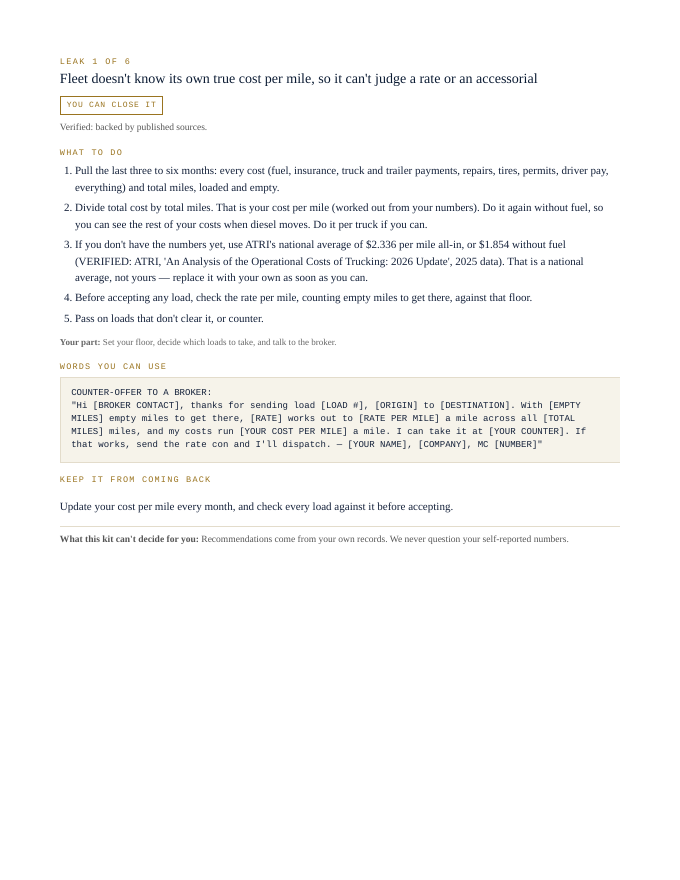
Fleet doesn't know its own true cost per mile, so it can't judge a rate or an accessorial
You can close it- Pull the last three to six months: every cost (fuel, insurance, truck and trailer payments, repairs, tires, permits, driver pay, everything) and total miles, loaded and empty.
- Divide total cost by total miles. That is your cost per mile (worked out from your numbers). Do it again without fuel, so you can see the rest of your costs when diesel moves. Do it per truck if you can.
- If you don't have the numbers yet, use ATRI's national average of $2.336 per mile all-in, or $1.854 without fuel (VERIFIED: ATRI, 'An Analysis of the Operational Costs of Trucking: 2026 Update', 2025 data). That is a national average, not yours — replace it with your own as soon as you can.
- Before accepting any load, check the rate per mile, counting empty miles to get there, against that floor.
- Pass on loads that don't clear it, or counter.
Your part: Set your floor, decide which loads to take, and talk to the broker.
COUNTER-OFFER TO A BROKER:
"Hi [BROKER CONTACT], thanks for sending load [LOAD #], [ORIGIN] to [DESTINATION]. With [EMPTY MILES] empty miles to get there, [RATE] works out to [RATE PER MILE] a mile across all [TOTAL MILES] miles, and my costs run [YOUR COST PER MILE] a mile. I can take it at [YOUR COUNTER]. If that works, send the rate con and I'll dispatch. — [YOUR NAME], [COMPANY], MC [NUMBER]"
Update your cost per mile every month, and check every load against it before accepting.
What this kit can't decide for you: Recommendations come from your own records. We never question your self-reported numbers.
That's 1 of 6. The other 5 come the same way in the kit: steps, words to send, a habit to keep each one closed.
Opens secure checkout. Instant download after payment. 30 days to ask for a refund — refund policy · terms
What people in this work look up
When small fleet carriers running 2 to 20 trucks go looking for answers, they search things like “fuel surcharge”, “fuel surcharge calculation”, “small trucking company” and “trucking cost per mile”. Those searches turn up forms, averages and other people's numbers. This kit starts from your own records instead: the 6 places money leaks in this work, where to look first and the words to send to close each one.
What you get for each leak
- Numbered steps to close each leak
- Your part, spelled out
- Words you can use: letters and scripts, ready to send (fill in the brackets)
- A habit that keeps each leak from coming back
- An honest line on what the kit can't decide for you
A page from the kit
Questions people ask
How do I calculate a fuel surcharge?
Check the base price, the MPG and the week's diesel price behind it. The kit shows how.
What's my fleet's real cost per mile?
Most small fleets don't know it, so they can't judge a rate. The kit walks you through it.
Can I see what the shipper paid the broker?
49 CFR 371.3 gives you that right. The kit shows how to use it.
What it can't decide for you
This kit works from your own records. It doesn't give legal, tax, licensing or financial advice, and it never tells you what to charge. Where a CPA, attorney, insurer or state board makes the call, the kit says so and gets your records ready for them.
10-page PDF · instant download after payment · Code VYR-KIT-CONVOY-01
Opens secure checkout. Instant download after payment. 30 days to ask for a refund — refund policy · terms
Use Jobber or Housecall Pro? Run the free leak check — it reads your job export in your browser and shows the money leaks the software doesn't flag. Nothing is uploaded.