The Water & Fire Restoration Fix Kit
Built for water and fire restoration companies.
Restoration money is won or lost on paper. The work is real, but what gets paid is what got written down: the water category on the first visit, the moisture readings every day, the equipment on site, the line items on the estimate, the signed authorization, and the check that still needs a mortgage company's endorsement. When the paper is thin, the drying days get cut, the supplement never gets written and the receivable sits. I wrote this kit to close those gaps one job file at a time, from your own logs, photos and payer records.
Opens secure checkout. Instant download after payment. 30 days to ask for a refund — refund policy · terms
The 11 leaks it covers
5 you can close it · 4 the other side owes it · 2 a pro decides
- Slow first response lets the loss growWhere to look first: Pull your last ten water jobs and write down the time of the first call and the time drying equipment was running.Keep it from coming back: Record call time and equipment-on time in every job file.You can close it
- Water category never documented on the first visitWhere to look first: Read your last ten job files and check whether the water category and its source are written down with photos.Keep it from coming back: Never leave a first visit without category, source and photos in the file.You can close it
- Drying days cut because daily readings are missingWhere to look first: Pull the jobs where a payer cut equipment days or monitoring visits last year.Keep it from coming back: No reading, no leaving the job. Every day, every room.The other side owes it
- Line items done on site but never written into the estimateWhere to look first: Walk one finished job file with the tech who did it and list every task actually done.Keep it from coming back: No estimate goes out until the closeout checklist is done.The other side owes it
- Older homes worked without lead-safe paperworkWhere to look first: Check the year built on every job before demolition starts.Keep it from coming back: Year built goes on the first-visit form.You can close it
- Insurance check sitting unendorsedWhere to look first: List every insurance check you have received that needs another party's endorsement, like a mortgage company.Keep it from coming back: Log every check the day it arrives, with the names of everyone who still has to sign.The other side owes it
- Work authorization and direction to pay unsigned or unclearWhere to look first: Pull your work authorization form and read it as a homeowner would.Keep it from coming back: No signature, no equipment, unless your attorney has said otherwise.A pro decides
- Contents packed out without a photo inventoryWhere to look first: Pull your last pack-out and check whether every box has a number, a room and photos of what went in.Keep it from coming back: Photos and a signed inventory both ways, every time.You can close it
- Drying equipment lost or idle across jobsWhere to look first: Count every dehumidifier, air mover and air scrubber you own.Keep it from coming back: Count the fleet every Monday.You can close it
- Subcontractor paperwork missing at year-endWhere to look first: List every subcontractor you paid last year: drywall, flooring, mold, electrical.Keep it from coming back: No W-9, no first payment.A pro decides
- Payers that pay slow, never totaledWhere to look first: List every invoice from the last year by payer: carrier, program, property manager or homeowner.Keep it from coming back: Review days to pay by payer every month.The other side owes it
Free: one full leak from this kit
No sign-up, no email. Here is leak 1 of 11 exactly as it appears in the kit, so you can see what you get before you buy.
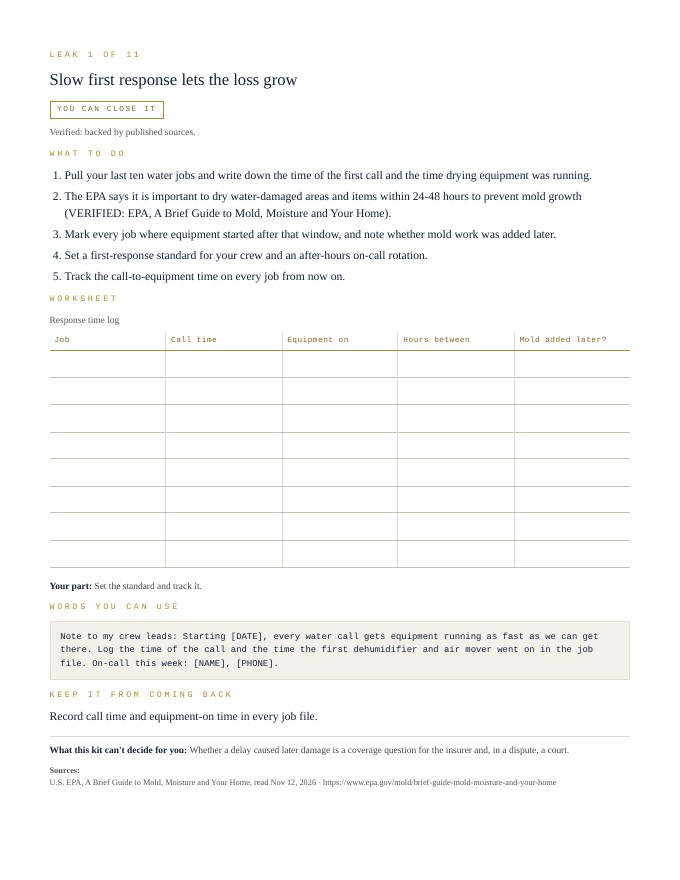
Slow first response lets the loss grow
You can close it- Pull your last ten water jobs and write down the time of the first call and the time drying equipment was running.
- The EPA says it is important to dry water-damaged areas and items within 24-48 hours to prevent mold growth (VERIFIED: EPA, A Brief Guide to Mold, Moisture and Your Home).
- Mark every job where equipment started after that window, and note whether mold work was added later.
- Set a first-response standard for your crew and an after-hours on-call rotation.
- Track the call-to-equipment time on every job from now on.
Your part: Set the standard and track it.
Note to my crew leads:

Starting [DATE], every water call gets equipment running as fast as we can get there. Log the time of the call and the time the first dehumidifier and air mover went on in the job file. On-call this week: [NAME], [PHONE].
Record call time and equipment-on time in every job file.
What this kit can't decide for you: Whether a delay caused later damage is a coverage question for the insurer and, in a dispute, a court.
That's 1 of 11. The other 10 come the same way in the kit: steps, words to send, a habit to keep each one closed.
Opens secure checkout. Instant download after payment. 30 days to ask for a refund — refund policy · terms
What people in this work look up
When water and fire restoration companies go looking for answers, they search things like “water damage restoration”, “xactimate”, “restoration company” and “fire damage restoration”. Those searches turn up forms, averages and other people's numbers. This kit starts from your own records instead: the 11 places money leaks in this work, where to look first and the words to send to close each one.
What you get for each leak
- Numbered steps to close each leak
- Your part, spelled out
- Words you can use: letters and scripts, ready to send (fill in the brackets)
- A habit that keeps each leak from coming back
- An honest line on what the kit can't decide for you
A page from the kit
Questions people ask
Slow first response lets the loss grow: where do I start?
Start here: Pull your last ten water jobs and write down the time of the first call and the time drying equipment was running. To keep it from coming back: Record call time and equipment-on time in every job file.
Water category never documented on the first visit: where do I start?
Start here: Read your last ten job files and check whether the water category and its source are written down with photos. To keep it from coming back: Never leave a first visit without category, source and photos in the file.
Drying days cut because daily readings are missing: where do I start?
Start here: Pull the jobs where a payer cut equipment days or monitoring visits last year. To keep it from coming back: No reading, no leaving the job. Every day, every room.
What it can't decide for you
This kit works from your own records. It doesn't give legal, tax, licensing or financial advice, and it never tells you what to charge. Where a CPA, attorney, insurer or state board makes the call, the kit says so and gets your records ready for them.
17-page PDF · instant download after payment · Code VYR-KIT-RESTORE-01
Opens secure checkout. Instant download after payment. 30 days to ask for a refund — refund policy · terms
Next step
- Run your free LeakReceipts check — it reads your own receipts and records and shows where money is leaking out, line by line.
- TrueNET — the whole-picture money truth: what you actually keep after every cost, across everything you earn and spend.
Use Jobber or Housecall Pro? Run the free leak check — it reads your job export in your browser and shows the money leaks the software doesn't flag. Nothing is uploaded.