The General Contractors & Remodelers Fix Kit
Built for general contractors and remodelers.
Contractors search markup, change orders and retainage, and that is where jobs lose money. It leaks through extra work done on a handshake, markup confused with margin, no job costing, retainage nobody chases, lien deadlines missed, subs with no insurance on file, lead-safe rules skipped on older homes, material prices that rose after the bid, card fees eaten whole, and quarterly taxes skipped. I wrote this kit so you can check each one against your own contracts, job files and books.
Opens secure checkout. Instant download after payment. 30 days to ask for a refund — refund policy · terms
The 10 leaks it covers
7 you can close it · 1 the other side owes it · 2 a pro decides
- Extra work done on a handshake, with no signed change orderWhere to look first: List the last five jobs. For each, write down every piece of work beyond the original scope and whether a signed change order exists.Keep it from coming back: Carry change order forms on every job site and in your phone.You can close it
- Markup confused with margin, so the job makes less than plannedWhere to look first: Pull your last five estimates. Write down cost and price for each.Keep it from coming back: Show markup and margin on every estimate.You can close it
- No job costing, so losing jobs hide inside winning onesWhere to look first: For your last five jobs, put every cost against the job: labor hours and burden, materials, subs, permits, dumpsters, equipment.Keep it from coming back: Close out every job with an estimate-versus-actual review.You can close it
- Retainage never chased at closeoutWhere to look first: List every job with retainage held: amount, contract terms for release, and completion date.Keep it from coming back: Put retainage release dates on your calendar at contract signing.The other side owes it
- Lien rights lost because a notice deadline passedWhere to look first: Mechanic's lien rules, preliminary notices and deadlines are set by each state. Look up your state's rules for every state you work in.Keep it from coming back: Fill in the checklist on day one of every job.You can close it
- Subcontractors with no insurance on file at audit timeWhere to look first: List every sub you paid last year and whether you have a current certificate of insurance for general liability and workers' comp.Keep it from coming back: Check certificate expiration dates monthly.A pro decides
- Lead-safe rules skipped on pre-1978 homesWhere to look first: If the home, child care facility or preschool was built before 1978, read the EPA's Renovation, Repair and Painting (RRP) program pages at epa.gov/lead before you disturb any paint.Keep it from coming back: Check the year built on every job before you bid.You can close it
- Material prices that rose after the bidWhere to look first: List jobs in the last year where material costs rose between bid and purchase. Total the difference.Keep it from coming back: Put the validity date on every bid.You can close it
- Card processing fees eaten whole, or surcharged against the rulesWhere to look first: Add up last year's card fees and divide by card payments (CALCULATED: fees / card volume).Keep it from coming back: Review card fees each quarter.You can close it
- Quarterly estimated taxes skipped on a good yearWhere to look first: If you own the business as a sole proprietor or partner, self-employment tax is 15.3% on net earnings once they reach $400 (VERIFIED: IRS).Keep it from coming back: Move the tax share the day each payment clears.A pro decides
Free: one full leak from this kit
No sign-up, no email. Here is leak 1 of 10 exactly as it appears in the kit, so you can see what you get before you buy.
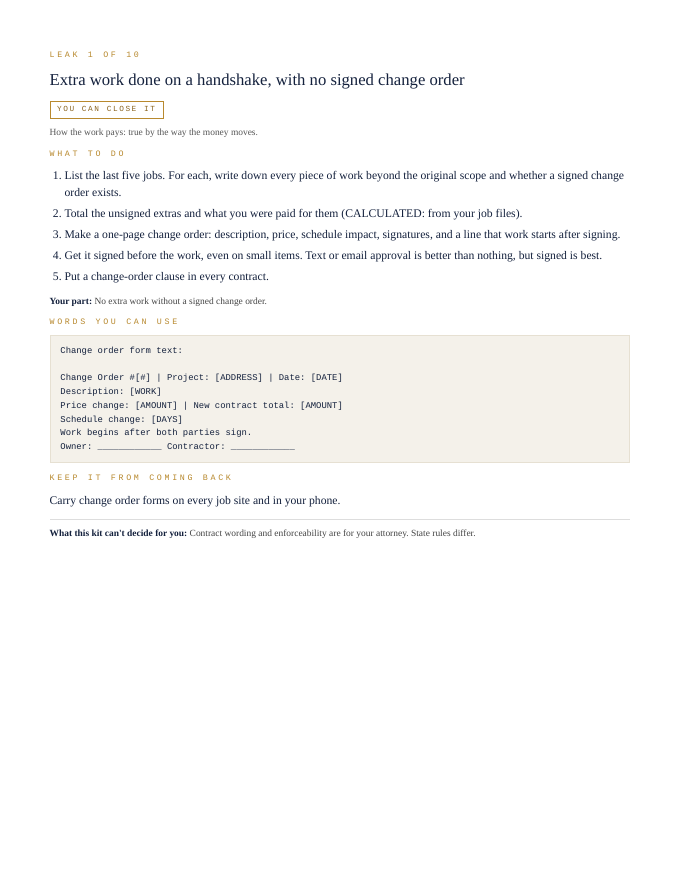
Extra work done on a handshake, with no signed change order
You can close it- List the last five jobs. For each, write down every piece of work beyond the original scope and whether a signed change order exists.
- Total the unsigned extras and what you were paid for them (CALCULATED: from your job files).
- Make a one-page change order: description, price, schedule impact, signatures, and a line that work starts after signing.
- Get it signed before the work, even on small items. Text or email approval is better than nothing, but signed is best.
- Put a change-order clause in every contract.
Your part: No extra work without a signed change order.
Change order form text:


Change Order #[#] | Project: [ADDRESS] | Date: [DATE]
Description: [WORK]
Price change: [AMOUNT] | New contract total: [AMOUNT]
Schedule change: [DAYS]
Work begins after both parties sign.
Owner: ____________ Contractor: ____________
Carry change order forms on every job site and in your phone.
What this kit can't decide for you: Contract wording and enforceability are for your attorney. State rules differ.
That's 1 of 10. The other 9 come the same way in the kit: steps, words to send, a habit to keep each one closed.
Opens secure checkout. Instant download after payment. 30 days to ask for a refund — refund policy · terms
What people in this work look up
When general contractors and remodelers go looking for answers, they search things like “general contractor markup”, “remodeling contract”, “change order” and “contractor retainage”. Those searches turn up forms, averages and other people's numbers. This kit starts from your own records instead: the 10 places money leaks in this work, where to look first and the words to send to close each one.
What you get for each leak
- Numbered steps to close each leak
- Your part, spelled out
- Words you can use: letters and scripts, ready to send (fill in the brackets)
- A habit that keeps each leak from coming back
- An honest line on what the kit can't decide for you
A page from the kit
Questions people ask
Extra work done on a handshake, with no signed change order: where do I start?
Start here: List the last five jobs. For each, write down every piece of work beyond the original scope and whether a signed change order exists. To keep it from coming back: Carry change order forms on every job site and in your phone.
Markup confused with margin, so the job makes less than planned: where do I start?
Start here: Pull your last five estimates. Write down cost and price for each. To keep it from coming back: Show markup and margin on every estimate.
No job costing, so losing jobs hide inside winning ones: where do I start?
Start here: For your last five jobs, put every cost against the job: labor hours and burden, materials, subs, permits, dumpsters, equipment. To keep it from coming back: Close out every job with an estimate-versus-actual review.
What it can't decide for you
This kit works from your own records. It doesn't give legal, tax, licensing or financial advice, and it never tells you what to charge. Where a CPA, attorney, insurer or state board makes the call, the kit says so and gets your records ready for them.
16-page PDF · instant download after payment · Code VYR-KIT-REMODEL-01
Opens secure checkout. Instant download after payment. 30 days to ask for a refund — refund policy · terms
Next step
- Run your free LeakReceipts check — it reads your own receipts and records and shows where money is leaking out, line by line.
- TrueNET — the whole-picture money truth: what you actually keep after every cost, across everything you earn and spend.
Use Jobber or Housecall Pro? Run the free leak check — it reads your job export in your browser and shows the money leaks the software doesn't flag. Nothing is uploaded.